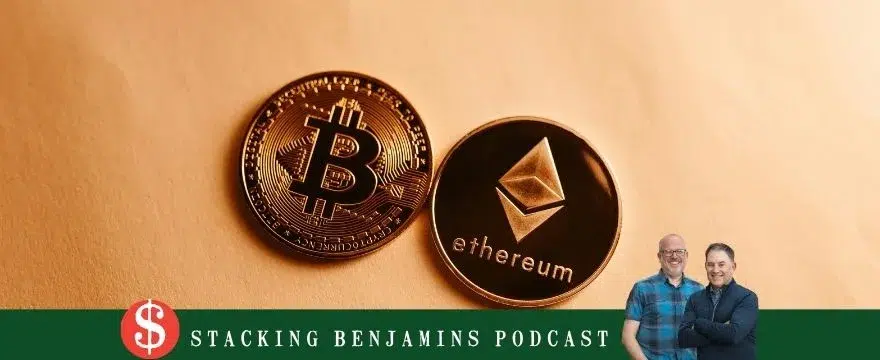
Blockchain. Stablecoins. Wallets. Staking. Halvings. If you’ve spent the last few years nodding confidently through crypto conversations while quietly hoping nobody asks a follow-up question — this episode is for you. Retired anesthesiologist and trading veteran Joe Duarte went from crypto skeptic to informed pragmatist, and today he brings the plain-English breakdown that most crypto content assumes you don’t need. No hype. No moon talk. Just the vocabulary, the mechanics, and the honest risks.
What You’ll Walk Away With
- What blockchain actually is — stripped of the jargon and explained in one sentence that actually sticks
- The real difference between Bitcoin and Ethereum — and why understanding those two unlocks everything else
- What a stablecoin is, why it exists, and the one comparison that finally makes it click
- The three crypto exchanges worth knowing — and why starting with the big names isn’t just convenient, it’s genuinely safer
- Hot wallets, cold wallets, and mobile wallets explained — and which one makes the most sense if you’re just getting started
- What staking is, what mining is, and why neither one is your first move as a beginner
- How crypto actually moves — the liquidity connection most investors miss entirely
- The tax trap that catches crypto beginners off guard — and why your record keeping has to be airtight from day one
- Why ETFs might be the smartest way for most Stackers to get crypto exposure without the operational headaches
- The long-term care reality hiding in this episode — and why 80% of people will eventually face a cost their current plan doesn’t account for
Why This Matters Now
Whether you’ve been crypto-curious for years or you’ve actively avoided the conversation, the landscape has changed enough that staying completely uninformed carries its own risk. Regulation is arriving, major brokerages now offer access, and the vocabulary has leaked into mainstream financial planning. You don’t have to become a believer — but understanding what you’re looking at puts you in a much better position to decide whether any of it belongs in your financial life.
From the Basement
Joe Duarte joins Joe and OG to translate the crypto dictionary for everyone who’s been faking it at dinner parties for the last decade. In the headline segment, Joe and OG dig into a sobering new AARP report on long-term care costs — and the conversation gets uncomfortably real about what most retirement plans are quietly missing. Doug arrives with trivia about the Bitcoin halving process, which turns out to have a name that required approximately zero creativity to invent. Whether the basement scoreboard reflects informed decision-making or something closer to Doug’s personal net worth is a question best answered with your earbuds in.
Resources Mentioned
Hegemony board game — referenced by Joe post-show; details at hegemonyproject.com
Cryptocurrency 101 by Joe Duarte — available wherever books are sold, with deals currently running on Amazon
Coinbase — coinbase.com, recommended starting point for US-based crypto beginners
Kraken — kraken.com, noted for advanced trading tools alongside beginner access
Binance — binance.com, largest global exchange; noted history with US regulators worth researching
NFCI Index — Chicago Fed’s National Financial Conditions Index, useful for tracking crypto-correlated liquidity at chicagofed.org
Genworth Cost of Care Study — annual long-term care cost data by state at genworth.com
AARP Long-Term Care Report — linked in show notes at stackingbenjamins.com
Stacking Benjamins Scorecard — stackingbenjamins.com/scorecard
Stacking Benjamins Vault — stackingbenjamins.com/vault
Stacking Benjamins Newsletter (The 201) — stackingbenjamins.com
Enjoy!



Our Mentor: Joe Duarte
Big thanks to Joe Duarte for joining us today. Grab yourself a copy of the book Cryptocurrency 101: From Blockchain and Bitcoin to Altcoins and Cryptocurrency Exchanges, Your Essential Guide to Understanding, Acquiring, and Using Cryptocurrency (Adams 101 Series)
Our Headline
Doug’s Trivia
- In Bitcoin mining, the reward is cut in half every 210,000 blocks. What is that process called?
Have a question for the show?
Want more than just the show notes? How about our newsletter with STACKS of related, deeper links?
- Check out The 201, our email that comes with every Monday and Wednesday episode, PLUS a list of more than 19 of the top money lessons Joe’s learned over his own life about money. From credit to cash reserves, and insurance to investing, we’ll tackle all of these. Head to StackingBenjamins.com/the201 to sign up (it’s free and we will never give away your email to others).
Other Mentions
Join Us Friday!
Tune in on Friday when we’re diving into your financial statements to hopefully help you save thousands.
Written by: Kevin Bailey
Miss our last show? Listen here: The Tax Triangle Most Investors Have Never Heard Of (SB1831)
Episode transcript
[00:00:00] opener: You should look into the bond market. That’s where the money is.
[00:00:03] Joe: Guns and junk bonds,
[00:00:05] opener: Jules, it’s high yield bonds. Do I tell people you’re in junk waitressing.
[00:00:16] Doug: Live from Joe’s mom’s basement. It’s the Stacking Benjamin Show.
[00:00:30] Doug: I am Joe’s Mom’s Neighbor, Doug, and in the spotlight today, crypto. Have you avoided cryptocurrencies until now, but could really use a 1 0 1 discussion. We’ve got your back with all the coins, exchanges, wallets, and more. It’s definitions galore with crypto and stock trading author Joe Duarte in our headline segment.
[00:00:51] Doug: More Ugly News about long-term care from A A RP. We’ll share the details and how that might change your plan. Plus, I’ll come sailing in with maybe the world’s best trivia question ever. Yeah, I said it well, you know, at least one as good as Mondays, which was pretty darn good. And now two guys who told me that while they were amazing Monday, today they are ready for even better stuff.
[00:01:18] Doug: It’s Joe and OJG.
[00:01:28] Joe: That’s right. Doug. Continuous improvement plan here in mom’s basement. Hopefully better every episode. So today, buckle up buttercup because we are bringing it in. The guy who I’m gonna rely on to make sure he brings it. ’cause I’m not sure how much I have in me today. It’s Mr. Mr. Oji.
[00:01:49] OG: Sorry I wasn’t paying attention.
[00:01:50] Joe: Perfect.
[00:01:50] OG: Am I supposed to, am I supposed to do something? Is that what you just
[00:01:53] Joe: said? We are. We are ready. So much better than on Monday. OG today we are getting into an area that neither you nor I really participated much crypto. I’ve owned some crypto. Have you ever bought any crypto?
[00:02:06] OG: I buy a hundred dollars of Bitcoin every Sunday.
[00:02:09] OG: Like clockwork.
[00:02:10] Joe: Just dollar cost averaging into Bitcoin.
[00:02:13] OG: Yeah, it is, um, super volatile. Um, I don’t expect to ever have this money available to me, ever. I don’t expect it to be worth anything in the off chance that it’s worth a bajillion dollars than yay. But I also think it’s important to, you know, know a little bit about a DA bunch of different areas.
[00:02:31] OG: So I do the thing that other people experiment with. I also experiment with it.
[00:02:36] Joe: That’s why I bought $2,000 of it just to see and to feel the emotions and to kind of understand what was going on. I’ve since sold it. I got my fill. However, I think it is important to your point, to be able to know what’s what.
[00:02:51] Joe: And you and I have been told through this great coaching organization that we both participated in called Strategic Coach Ask Who not how. And for me, there’s so many bad actors in the crypto space, OG, that
[00:03:04] OG: the talk to a girl.
[00:03:07] Joe: Yeah. I don’t, I don’t believe any of them.
[00:03:10] OG: Yeah.
[00:03:10] Joe: I don’t believe. And look at how she got taken, you know?
[00:03:12] Joe: I mean she’s,
[00:03:13] OG: yeah, she claims to be a victim.
[00:03:15] Joe: Maybe she got taken, maybe she didn’t. But certainly not the who you wanna learn from. Joe Duarte is a guy whose work I’ve been reading for a long time. Joe is a retired anesthesiologist. He’s a guy who likes diving into how individual stocks work and how to understand the stock market.
[00:03:33] Joe: He understands stock, buy and hold. He understands stock investing. And when I heard that Joe Duarte was getting into crypto. And could explain on a one-on-one basis what all these terms are. What you gotta know. He was the guy who was, I think OG a great who for us. So he’s not somebody who is gonna tell you.
[00:03:55] Joe: It’s fantastic. I would bet he’s upstairs talking to mom now, so we’ll see. But I think Joe Dardi is gonna say exactly what you just said, og, that there’s a little bit of buyer beware here. However, a lot of people participate. A lot of people have made great money in it. My brother-in-law, one of them, he’ll, he’s, he’s done phenomenally well at it and is also a believer in the future of cryptocurrency and what it’s gonna do.
[00:04:18] Joe: So Joe Dardi is going to join us today. I’m really excited about that. Before we get to him though. Stacking Benjamins has a couple sponsors that help us keep on keeping on, and we play just a couple of these sponsor spots at the beginning and then we only have a couple more during Doug’s trivia. And that’s it for the entire episode.
[00:04:37] Joe: We have one sponsor that is very near and dear to us, and that is The Vault. That’s because we partner with the teams that are Ray and Budget simple. Budget simple. Working very hard right now because in the very, very near future we’re gonna be able to help you with the vault, track your net worth, and get your budget in order at the same place.
[00:04:56] Joe: We’re already helping you with privacy, your identity, your subscriptions. It is the Swiss Army Knife. Why have seven different places to do all these things when you could have just one Stacking Benjamins dot com slash vault. So big, big, exciting news from the Vault, of course. A couple more sponsors.
[00:05:15] Joe: We’re gonna hear from them. And then Joe Duarte joins us to share with us Cryptocurrency 1 0 1.
[00:05:30] Joe: And I am super happy. This gentleman’s making his way down to mom’s basement. Joe ARDI’s here. How are you?
[00:05:36] Joe Duarte: I’m doing great. It’s 80 degrees outside. It’s super windy and uh, cloudy and we’re gonna have a storm and I’m not in any of that, so. Things are looking up.
[00:05:45] Joe: I know it’s always better, Joe, to be in mom’s basement during that time.
[00:05:48] Joe: One of the few times people say it’s better to be in mom’s basement. But here’s the reason why I wanted to talk to you, because I’ve been following your work for a while, Joe, I know you as an options guy. I know you as a basics of investing guy. You’ve taught people in their twenties and thirties how to invest.
[00:06:08] Joe: So when I see that Joe Dardi is involved in writing a book about cryptocurrency, I was like, wait, what? How did you first get introduced to cryptocurrency? What’s your background been?
[00:06:21] Joe Duarte: It’s like everything else for me. I just think that things happen for a reason and a lot of the things in my life that have happened are just.
[00:06:29] Joe Duarte: Chance meetings and things that develop from there. As you say, I’ve been trading options and stocks for, you know, since 19 87, 19 90, depending on whatever timeline you wanna use. I’m an anesthesiologist, retired now, and I trade for a living. But I’ve found out early that the same skills that make you a good anesthesiologist, the ability to observe and to react rapidly.
[00:06:55] Joe Duarte: And to be correct when the situation calls for it are the same things that make you a successful trader or investor.
[00:07:03] Joe: It’s interesting Joe, because being an anesthesiologist, ’cause I have a couple friends who are anesthesiologists most of the time doing nothing is the right move. Right?
[00:07:13] Joe Duarte: Yeah. My old department chairman always said anesthesia was like 99% boredom and 1% sheer panic.
[00:07:20] Joe Duarte: And that pretty much describes investing. How I got started in crypto is kind of through the back door. I was like many people a skeptic. I mean, what is this thing? Uh, I don’t understand it. What is all this volatility in the prices? What can you do with it? You know? Those are the things that used to occasionally come in my mind and then I’d go back trading stocks, but one thing led to another and, and, and the thing just didn’t go away.
[00:07:47] Joe Duarte: Cryptocurrencies I think are here to stay like ’em or not. So I said, you know what? It’s probably a good time. For an old guy like me that trade stocks and options to kind of see if this thing is worthwhile. You know, I’m big on price charts, uh, as you well know. And when I see something that moves like crypto does, it gets my attention because you can make money on the upside and you can make money on the downside.
[00:08:17] Joe Duarte: And so as a skeptic, I missed that, but as I became more interested, I became more aware of it. And so to me, crypto is an asset class that can be invested in and it can be traded. And when it goes up, you can trade it going up. When it goes down, you can trade it going down if you’re, you know, inclined that way.
[00:08:40] Joe Duarte: If you don’t want to trade it on the way down, then you can wait for it to bottom out and go back up again. If you want to buy some crypto and hold it till the end of time, then you’re welcome to do that too. So the bottom line is, I went from a non-believer to a pragmatist. I’m not one of those people that has put all my money in crypto and I don’t really think I want to, but if that’s what you’d like to do, then you better read up because it’s complex and complicated at the same time.
[00:09:15] Joe Duarte: So I think that’s kind of a good starting point for where I am. And just to clear up, the reason I wrote this book is because, number one, someone asked me to, but number two, it was a challenge, you know, I said, okay, if I write this thing, then I’m really gonna have to buck up and I’m really gonna have to dive in.
[00:09:33] Joe Duarte: I’m really gonna have to learn the ins and outs of this stuff. And, uh, it has really worked out for me because now my trading is so much more informed than it was before I wrote this book.
[00:09:46] Joe: I wanna give everyone the question, I think at the end of the interview, I’m gonna save it, but I’m gonna wanna ask you what surprised you as you were tease your term, bucking up on it.
[00:09:56] Joe: That’ll be I think, interesting, but I think we gotta start at the beginning because I might be, Joe, where you were when you began your journey. Because I gotta be honest, every time somebody says the word blockchain, I nod like I understand, right? And then immediately I hope nobody asks a follow-up question.
[00:10:15] Joe: ’cause if they do, they’re gonna see, I don’t know what the hell I’m talking about. So let’s start there because you’re gonna be our translator for the rest of us fakers. What the hell is blockchain?
[00:10:26] Joe Duarte: So blockchain is nothing more than an online ledger system. That’s really all it is. It’s where all the crypto transactions are logged and stored.
[00:10:38] Joe Duarte: Okay. And you can make it as complicated as you want, but that’s basically what it is. It’s a record keeping system. Now, there’s plenty of nuance to it and there’s plenty of complicated stuff that goes along with it. And if you wanna dive in, you, you can just spend days just learning about blockchain, the cryptographic stuff, you know, to say, Joe Blow bought this from Mr.
[00:11:02] Joe Duarte: Smith. You know, it’s like a hundred letters, but at the end of the day it, it’s just a record of a transaction.
[00:11:10] Joe: Was there a problem this was trying to solve in the first place? Initially,
[00:11:14] Joe Duarte: the reason crypto was created was, you know, there’s plenty of people that did bits and pieces before Mr. Nakamoto. The guy that invented Bitcoin and all that.
[00:11:28] Joe Duarte: The bottom line was people wanted to conduct transactions with anonymity and lower fees and without having to wait for a third party, such as Chase Bank or the Federal Reserve or the US Treasury, to say it’s okay for this to happen. And that’s where the term decentralized finance comes from, that famous buzzword.
[00:11:54] Joe Duarte: And crypto is like all buzzwords, you know?
[00:11:56] Doug: Right,
[00:11:58] Joe: right.
[00:11:58] Joe Duarte: The defi, the decentralized is all about taking out the middleman. And of course later on we can come back to it and talk about how the middleman is trying to horn in, but that’s a totally separate top.
[00:12:12] Joe: As I’m listening to you today, and as I was reading, I kind of felt like it is both revolutionary, but also like the next version of Excel.
[00:12:20] Joe: But easier to move from point to point with like a better PR team. You know what I mean?
[00:12:26] Joe Duarte: Well, the thing about crypto is that whenever something happens, it’s always followed by a hundred million other things that are related to it. If you wanna get into the nitty gritty of the definition of complexity, which is lots of moving parts bumping against one another till I get to a certain place and then something happens that’s crypto, it’s always moving, it’s always evolving, and just when you think you understand what’s going on, it changes.
[00:12:57] Joe Duarte: You know? That’s why there’s so many different coins out there. There’s 4, 500, 600 coins and it’s nutty.
[00:13:04] Joe: I’m glad you brought that up because understanding blockchain for me was step number one. Like, what is this?
[00:13:11] Joe Duarte: You got it now?
[00:13:13] Joe: I do, I do. I got the record keeping, like the basic is, this is record keeping, but if blockchain’s the engine, then Joe, let’s look at what are the actual cars people are driving.
[00:13:22] Joe: You’ve got these things, Bitcoin that you mentioned earlier, Ethereum and all the others, like what’s the difference in plain English? Are these competing or are they doing different jobs?
[00:13:32] Joe Duarte: The answer is yes and no. Okay. I think for a beginner, you wanna get familiar with Bitcoin because Bitcoin is the central cog in the entire Bitcoin operation.
[00:13:44] Joe Duarte: Once you understand the Bitcoin, then you can add extra pieces and bits of knowledge to it. So you, you, you gotta get your, your arms around Bitcoin first and Bitcoin is essentially for payments. For investing and trading. Those are really all of its major functions. Ethereum, on the other hand, evolved after Wait for it, wait for it.
[00:14:11] Joe Duarte: There was a hack, of course, the system decided, you know what, this doesn’t work. So we’re gonna move on and form a new Ethereum blockchain. And what we wanna do is we want to be the centerpiece for commercial activity investing and everything on the Web3 or web number three. So where you can invest in trading Bitcoin, Ethereum, you know, you can actually make a whole lot more transactions.
[00:14:42] Joe Duarte: It’s, it works faster than Bitcoin, uh, in many cases. And it’s really just a question of what you’re looking for. If you understand those two, then you can understand the rest of them, because they’re all variations on that theme.
[00:14:58] Joe: But to some degree then what you’re saying is it truly is a little bit Coke versus Pepsi versus trucks or motorcycles.
[00:15:07] Joe: Which do you know, I guess trucks and motorcycles have different functions, but they both are vehicles. This smells to me, based on your explanation, like this is more of a Coke versus Pepsi,
[00:15:18] Joe Duarte: in a sense. It is, and a lot of it depends on how far you wanna dive into this thing.
[00:15:23] Joe: Okay.
[00:15:24] Joe Duarte: I just want to trade. But if you’re a true believer and you really don’t want to deal with dollars and pounds and euros and you’d rather deal in Ethereum, then there’s a huge ecosystem you can pay for travel costs.
[00:15:39] Joe Duarte: With Ethereum, you can pay your bills in some cases with Ethereum, you can even buy groceries in some stores and there’s always some finagling with some app or something or other, you know, but what do you wanna do with it? Get to know the things first and then figure out what you wanna do with it.
[00:15:57] Joe: Uh, let’s do a quick lightning round because there’s a bunch of words people pretend to understand at parties and they don’t much, again, let’s I do the head nod, but can you give us a, a very quick, what is stablecoin?
[00:16:11] Joe: I hear people talk about stablecoin. What is that? A
[00:16:14] Joe Duarte: stablecoin is nothing more than a cryptocurrency. That is. Pegged to an asset and it’s supposed to stay stable in price.
[00:16:24] Joe: Is this almost like a different economy will peg their dollar to the US dollar, that type of thing?
[00:16:30] Joe Duarte: Same sort of dynamic and principle.
[00:16:33] Joe: Okay.
[00:16:33] Joe Duarte: A stable coin is basically, again, a perfect example of how the crypto dynamic evolves. Boy, this thing’s volatile. We wanna still do crypto, but can we make it stable? So how are we gonna do that? And then the stable coin concept developed and so now you have stable coins that you know, basically fluctuate a few pennies above or a few pennies below the US dollar if they’re pegged to, to the dollar.
[00:16:59] Joe: I would guess then, Joe, the selling point here is for people that really want to use it as currency, not as trading, because I would guess stable’s a big selling point in a world crypto has kind of become synonymous with chaos to some degree.
[00:17:13] Joe Duarte: I agree. It is chaotic at times because pure crypto trading.
[00:17:18] Joe Duarte: Bitcoin, Ethereum and the rest of ’em it’s volatile. A stable coin is, is something that you can use for commerce, and this is kind of crude and the true believers might not agree, but you can sort of think of stable coins as a money market fund type vehicle for crypto. And I mean that in the sense of you can, uh, what they call stake your stable coins, meaning that you can loan them and collect interest on them.
[00:17:48] Joe Duarte: That gives it that money market fund feel. Or you can just leave it there and you know, if you have 10,000 stable coins, it’s gonna be 10,000 whenever you need it, you know, to buy your next trade of Bitcoin or, or to pay for your groceries, whatever it is, depending on the situation.
[00:18:06] Joe: You know, Joe, it’s interesting.
[00:18:07] Joe: We spoke with an economics professor and a research fellow from Cornell a number of years ago, and I remember him talking about crypto in the early days we had him on, and he was talking about you’re going to see central banks get involved. And he was the person that introduced to me this idea of central bank digital currency.
[00:18:29] Joe: It appears that has become the case around the world. We have lots of central bank digital currency, but do you mind giving us the quick Cliffs notes to what Central Bank digital currency even is?
[00:18:40] Joe Duarte: Again, simple concept. The most accessible central bank digital, uh, currency is the, uh, digital w in China.
[00:18:49] Joe Duarte: It’s basically a digital version of the w You can pay for bus rides or whatever it is you’re gonna pay with your digital wallet. And it’s the same as if you had a, a, a wand bill and you put it in the box. That’s not the same thing. As a cryptocurrency, central banks don’t have control over cryptocurrencies.
[00:19:12] Joe Duarte: In fact, in the United States, there’s, there was a law that was passed, uh, in 2025 along with the so-called Genius Act, uh, which regulates, um, stable coins. And that says that the Federal Reserve cannot have a central bank digital currency because if they do, then they can snoop into everyone’s financial transactions all the time without having to, to go through any quarter or anything like that.
[00:19:40] Joe: That comes with the territory in China. Then with the digital one, like the government is watching you pay for your bus ride.
[00:19:46] Joe Duarte: Right? Right. And, and then that’s the thing about Central Bank digital currencies. If you have one. Then the government knows what you’re doing and that goes against the original tenants of crypto, which was anonymity and ease of transaction.
[00:20:02] Joe: Well then what is an electronic US dollar? Because you also write about this in Cryptocurrency 1 0 1.
[00:20:07] Joe Duarte: Well, an electronic US dollar is, is another offshoot of the stable coins and it’s not one I’m very familiar with. I think the best thing to do is to stick with the big ones, tether and USDC. Those are the big ones.
[00:20:22] Joe Duarte: That’s where you start when you’re talking about stable coins, you want to stick with the, with the big ones. And a lot of it has to do not just with being hip, ’cause you’re trading the big ones or you’re dealing with the big ones. It has to do with liquidity. It has to do with privacy. And it has to do with the fact that if you trade with a, with a discount broker that’s not very reputable and you compare it to something like Fidelity.
[00:20:48] Joe Duarte: That’s the same kind of vibe, at least when you first get started. You wanna stay with the big guys.
[00:20:53] Joe: Yeah. This truly still is in a lot of these smaller coins. My understanding from you and from others, Joe, is that this truly is the wild west. I mean, if you stick with the big guys, there’s more safety in numbers.
[00:21:04] Joe Duarte: The problem with crypto is that there are still huge potential for the big two nasties. I call ’em, you know, hacks and scams just the other day, and I, I, it escapes me right now who got hacked because it happens so often. But again, a fairly big operator with an app of some sort that, uh, I don’t use and I’m never, never gonna use, got hacked.
[00:21:28] Joe Duarte: And I’m thinking, guys, we’ve been at this for a good 15, 20 years now, one way or another, you’d think the security would be a little bit better in some of these things. So that’s why I’m always saying, at least in the beginning, before you learn. A lot. Detail. Detail and gain some experience. You wanna stay with the, the big ones.
[00:21:46] Joe Duarte: If you’re gonna go with the regular crypto, Bitcoin and Ethereum, if you’re gonna go with, uh, stable coins, USDT, which is Tether and uh, usdc,
[00:21:57] Joe: I feel like this is going into your more natural world, Joe, the world of options, you know, what you’re telling us is write a few covered calls using a big broker.
[00:22:07] Joe: You know, use this in a very conservative way so that you don’t get killed. Speaking of using this stuff, by the way, let’s say I am convinced or I’m at least crypto curious, I need to now use it myself. You mentioned, uh, some of these places that might get hacked in exchange, is that like a Schwab or a Fidelity, but for crypto?
[00:22:28] Joe Duarte: Yes. The short answer is yes. And there’s, there’s three of them that, that are really the gold standards. Not without risk and not without nuance, but Coinbase is based in the United States. And, uh, it’s highly rated and highly reliable and efficient. Okay? And it’s actually considered the best place for many beginners to start.
[00:22:51] Joe Duarte: The other one is Binance. They were originally based in China. They’re huge. They’ve had their problems, you know, they, they got busted for money laundering and they had to pay the US government billions and their CEO got fired, you know, then he got pardoned by Trump, if I’m not mistaken. So, you know, again, even the big guys, you have to be very cautious about what you do and how you do it.
[00:23:15] Joe Duarte: And then there’s the, there’s a lesser known one known as Kraken, and Kraken was actually the first real exchange. That one is sort of an in-between, you know, it’s, it’s like okay for beginners, but also has a lot of big time pro-grade stuff. You know, technical analysis. You can trade options, you can trade futures, you can do all kinds of.
[00:23:37] Joe Duarte: Very aggressive things on Kraken and, and you can as well on Coinbase and finance, but that’s what Kraken is, is is basically known for
[00:23:45] Joe: much like I store my dollars in a wallet, you have wallets for your crypto and you’ve got these three different types of wallets, hot wallet, a cold wallet, and a mobile wallet.
[00:23:57] Joe: Like why does this all sound like I need a survival kit, Joe?
[00:24:00] Joe Duarte: Well, so it’s again, simple. A hot wallet is always connected to the internet. And so that’s the wallet basically that you set up when you open your account at Binance. And not to be confused with Binance Wallet, which is a separate entity that’s affiliated with it.
[00:24:18] Joe Duarte: That’s, you know, keeping it simple. So Hot Wallet always connected to the internet. Cold Wallet is one where you actually have like a gadget that you store all your keys and, and your information and, and that only gets connected to the internet when you plug it in. To your computer or through whatever wifi or other method of connection you decide to use for a mobile wallet is sort of like a hot wallet that’s not always connected.
[00:24:51] Joe Duarte: Again, it’s kind of a hybrid thing, but more than anything else, it works on your cell phone, you know, and, and, and then of course there’s apps and the more apps, the more goofy things get, so you, you just gotta be careful. You wanna keep it simple. If I was going to do something like that, I would probably use either a hot wallet through the exchange, the big exchange, or use a reputable cold wallet.
[00:25:17] Joe: It’s interesting because this idea of a mobile wallet sounds to me almost like the. You know how credit freezing used to be really hard. Now you can credit freeze just by doing a slider. It sounds like that’s what they’re kind of solving for. It’s the same thing. I could just slide it on my phone to make it hot or cold, depending on,
[00:25:34] Joe Duarte: you know, again, it involves apps and in my opinion, when you throw an app in into crypto, you’re adding a a different level of complexity.
[00:25:44] Joe Duarte: And so that’s not what I would do to get started. I would keep it as simple as possible.
[00:25:49] Joe: You mentioned a word earlier called staking. You just mentioned it in passing. That sounds like grilling, making a stake, not investing. What is staking?
[00:25:58] Joe Duarte: It’s basically you’re loaning your crypto to someone for a payoff.
[00:26:03] Joe: Oh.
[00:26:04] Joe Duarte: Yeah, there’s multiple, multiple ways of doing it, you know, directly, indirectly, what they call peer-to-peer and so on and so forth. Again, that wouldn’t be my first step in crypto. I would look at it and research it carefully and make sure that I was gonna give my money back within a certain amount of time.
[00:26:24] Joe Duarte: It gets to the point where if, uh, the network is busy, your payments might get delayed on staking, like I said earlier, you know, crypto is like you hit one button and then 150,000 other buttons go off at the same time simultaneously. That make everything complicated.
[00:26:44] Joe: And the last term that I wanted to bring up today for our 1 0 1 is this idea of mining.
[00:26:49] Joe: So do I need a warehouse and a power plant or can I do this next to my Peloton, where I’m, uh, mining? What’s mining all about?
[00:26:58] Joe Duarte: Well, mining is where you set up a computer rig and then you plug it to a platform. And then you compete for creating Bitcoin or validating transactions, and if your computer wins, then you get paid.
[00:27:12] Joe Duarte: The problem with it is that large corporations have warehouses full of servers that are competing with you, which means that once in a while you might get lucky and crack the code before someone else does. But most of the time, direct crypto mining is prohibitively expensive for most people and it’s got all kinds of other problems.
[00:27:36] Joe Duarte: Like it’ll make your house so hot you could even catch on fire. So you have to invest in cooling systems and all kinds of things.
[00:27:42] Joe: Let’s talk about where people get burned. You mentioned you like it to invest in it. Should this be an investment for most people when they’re starting out? Is that the wrong way to think about it?
[00:27:58] Joe: And then what’s the biggest investing mistake? Assuming that the answer is yes to that, that yeah, investing in it is good. What’s the biggest mistake beginners make?
[00:28:11] Joe Duarte: Rushing in? That’s the biggest mistake. I don’t think you should put a penny into stocks or options or crypto or bonds or anything if you don’t know what you’re getting into.
[00:28:25] Joe Duarte: That’s the number one mistake. The number two mistake is not just rushing in, but rushing into the wrong thing. Some people might wanna, you know, they think they’re gonna, oh, you know, what the heck? So they open an account at some mom and pop exchange that’s gonna scam them instead of researching, you know, Binance and Kraken and, and Coinbase and doing it there.
[00:28:48] Joe Duarte: The other thing too is that. If you want to trade and invest in crypto, you don’t even have to deal with Coinbase or Binance or Kraken. Fidelity has a platform, and Robinhood has a platform through which you can trade real crypto. My best bet for beginner or people that just wanna invest in it is through ETFs, and that’s something we obviously will be talking about in some detail later, but that’s really my best approach, especially at the beginning.
[00:29:17] Joe: Is there a point when the IRS shows up and ruins the party? Joe
[00:29:21] Joe Duarte: always, and with crypto, when you trade crypto directly, every time you make a sale or make a payoff to someone or receive money, that’s a taxable transaction. So your record keeping has to be pristine. And the second, uh, the correlator to that is if you use an accountant, make sure your accountant is very well versed in understanding the way crypto taxes work.
[00:29:49] Joe: Let’s talk a little bit about investing in it then. So I buy, I decide to go with an ETF, or I decide to set up an account at Coinbase. I buy one of the big ones. You mentioned I can make money on the way up and I can make money on the way down. Is this because I’m trading some type of an option on Bitcoin?
[00:30:08] Joe Duarte: Well, you can, you know, you can do just about anything. If you just trading and you decide to buy, let’s say you have a huge account and you know a lot of money, and like right now you have $70,000 that aren’t doing anything and you think Bitcoin’s bottomed. So you can buy one coin for 70,000 and you can do that through your Coinbase account or you can do that through your Fidelity account or your Robinhood account if you’re lucky.
[00:30:35] Joe Duarte: I mean that sincerely, because crypto is, a lot of it is luck. If it goes up $10,000, then you want to sell it, then you hit the the sell button and you got, they’ll do the transfer and whatever transaction, and you’ve got $80,000. You know, so you just made $10,000. The other hand, crypto, let’s say it’s saving at 80,000, and you decided you want to sell it short, which is crazy stuff because crypto is nuts to start with.
[00:31:07] Joe Duarte: So you’re selling Bitcoin short, but you’re lucky and it goes down, you know, 10,000 to 70,000 and you cover your short position at that point, then you just made $10,000. You can do the same thing with an ETF. You know, there’s ETFs like, you know when crypto goes up they go up. When crypto goes down, they go down.
[00:31:26] Joe Duarte: That’s the pure trading side of it.
[00:31:28] Joe: Gotcha. You know, we’re starting to, I know, amass some data finally around how crypto moves because initially I know crypto was being compared to gold, like the new gold, but clearly it’s not the new gold with all the volatility. Joe, so you mentioned that you like looking at charts, you like seeing how the chart moves.
[00:31:47] Joe: How really does crypto move or is it purely the wild west? Speculation?
[00:31:54] Joe Duarte: Yes and no. Crypto has evolved into becoming the canary in the coal mine for liquidity, which is the amount of money that’s in the system, financial system that’s basically sloshing around. When the Fed lowers interest rates, it increases liquidity and when it raises interest rates or does other nebulous things to tighten liquidity, you know, the liquidity falls.
[00:32:19] Joe Duarte: So if liquidity is ample, you know, there’s a great way to know where it’s sample or not. There’s an index called the NFCI index, and you can find that at the Chicago Feds website. So it’s not like there’s any mystery to how much liquidity’s in the system, but crypto reacts to liquidity before anything else does routinely.
[00:32:41] Joe: Wow. So you’ve got a lot of correlation then with, uh, fed activity when it comes to watching your crypto.
[00:32:49] Joe Duarte: Yes and no. It’s not like stocks and bonds, though. It’s purely a functional liquidity. The Fed doesn’t have to, uh, alter liquidity with interest rates. It can just do so by other stuff. Okay. I don’t, I don’t want to get into the weeds with this, but
[00:33:02] Joe: Yeah, sure.
[00:33:03] Joe Duarte: When it decides to flood the system with money, look for crypto rise basically, and the opposite.
[00:33:09] Joe: Gotcha. So right now we’re seeing a lot of money being taken outta the system. I would guess just from looking at the Bitcoin chart where it sits as we record this versus just a few months ago. I mean, you know, Bitcoin is almost cut in half.
[00:33:22] Joe Duarte: Right? And, and it all started in October of last year of 2025. There were some rumblings of some problems in, in the so-called private credit arena, which is, you know, basically people that will never be able to pay back their loans, like the subprime thing. Just a different version of that. And that started causing some trouble and the liquidity started drying up.
[00:33:46] Joe Duarte: And so Bitcoin crashed before everything else did. But now stocks have, have caught up. And then of course with this war thing, you know, every day is a new day.
[00:33:55] Joe: Sure. Right, right. You know, it’s funny, I caution star, uh, beginners and you’re somebody that has trained a lot of beginners as well, Joe. So. I’m curious about your take on this.
[00:34:05] Joe: I caution people about playing these stock market games because as you know, I like it for the technical aspect. Like, this is how you place the trade, this is how the trade moves. I get to watch all that, but I also caution people because when you’re using real money, you’re gonna feel emotions way differently, way, way differently.
[00:34:26] Joe: And you’re gonna make moves differently because of those emotions. When you trade with real money, do you feel the same If somebody wanted to, you know, play with a simulator in this area?
[00:34:38] Joe Duarte: I think I call it, I’m an old fashioned guy, so I call it paper trading.
[00:34:42] Joe: Yeah,
[00:34:43] Joe Duarte: it’s the same thing. In fact, I encourage that.
[00:34:45] Joe Duarte: I don’t think you should put any real money into any investment without at least paper trading it or simulating it for a while till you get the feel of how things work. It’s a layering. You have to understand a lot of things like the fed liquidity, all the macro stuff. The way this responds to that, you know, the beautiful thing about cryptocurrency is it only responds to one thing or actually two, liquidity and supply and demand period.
[00:35:15] Joe Duarte: If liquidity is example, you know, and more people want to buy crypto, it’s gonna go up. It’s really that simple.
[00:35:21] Joe: I want to, uh, ask you just a couple questions from the very end of your book, which is, and there’s so much more here, stackers, there’s so much more in cryptocurrency 1 0 1 that we’re gonna be able to cover today.
[00:35:32] Joe: It was a fascinating read for me, Joe, but let’s fast forward 10 years. What does crypto get right? You think 10 years from now,
[00:35:40] Joe Duarte: more than anything else, it’s gonna offer access to people that don’t have access to the financial system Now, and what I mean by that is that, for example, there’s a Brazilian bank called New Holdings and you, and you know, they’re heavily into crypto.
[00:35:56] Joe Duarte: They’ve built an ecosystem for crypto. And so people in Brazil and throughout the world that use their services have access to cryptocurrency and, and, and cryptocurrency type transactions. You know, the number two thing, and this is kind of a little bit complex and complicated because of stable coins needing to be backed by dollars and treasuries.
[00:36:21] Joe Duarte: That sort of saves the dollar from extinction. You know, you all you hear about is, oh, we’re going through the dollarization. The dollar will never, we’ll stop being the world’s reserve currency. I’m going, well, yeah, maybe, but not in my lifetime, because there’s this crypto thing, the stable coins, whoever thinks about these things and puts them in motion, they’re kind of scary.
[00:36:46] Joe Duarte: Okay. That’s all I’m gonna say.
[00:36:50] Joe: Well, you think about the, the cynics who had been hanging out with us, uh, listening to this, and you were a cynic at one point. And I certainly, I remember laughing at my brother-in-law and he has, he’s amassed a, a nice stack of, uh, bitcoin just by holding and being a true believer where I was not, but no less than Jamie Diamond at JP Morgan Chase is talked about.
[00:37:12] Joe: There’s nothing behind this. And even though they fuel the system in a lot of crypto transactions, Jamie Diamond has even said there is this aspect of, it’s the last one holding the bag loses. Do you see it that way or is it, is that too cynical?
[00:37:29] Joe Duarte: Well, it’s the same thing with stocks. Investments are risky,
[00:37:32] Joe: but at least with a stock, you’ve got Coca-Cola.
[00:37:35] Joe: They’re making Coca-Cola behind it. What’s behind Bitcoin?
[00:37:38] Joe Duarte: Someone is willing to own it. Supply and demand and liquidity, and as long as people believe that Bitcoin is a method of preserving value and doing transactions, it’s been around too long now and the government is now regulating it, and Jamie Diamond himself trying to figure out how to get into it.
[00:38:02] Joe: It’s funny ’cause he’s saying that on one hand, Joe, and on the other hand, you look at what JP Morgan Chase does in the crypto markets, they’re participating wildly participating in the crypto markets
[00:38:13] Joe Duarte: and they want control of the crypto market. That’s why we can’t pass any legislation. The crypto people want control and the big banks now want control and so that’s why Congress can’t pass the final bit of legislation.
[00:38:27] Joe Duarte: There’s, you know, there’s the three XI talked about before, which have provided some safety to this space, but it’s this fight between traditional money and the defi group that’s holding things up.
[00:38:40] Joe: I promised at the beginning when you said you really had to do a deep dive into all of it. You knew a lot of crypto, but you really had to be an expert to do a project like this.
[00:38:48] Joe: Joe, what really surprised you when you were writing cryptocurrency 1 0 1?
[00:38:53] Joe Duarte: The depth and the complexity and what seems to be a never ending cycle of change. If I lived another 30 years, I’d still be scratching my head going, wow, how did they think of that? My wife can’t stand it. I, I go down the stairs and, and I’m scratching my head going, Hey, you know what?
[00:39:12] Joe Duarte: I just read honey. And she goes, she goes, no. Oh my God. Are you gonna talk about crypto again?
[00:39:21] Joe: Oh, Joe, thank you so much. The book is Cryptocurrency 1 0 1 for blockchain and Bitcoin to alt coins and cryptocurrency exchanges. It’s your essential guide to understanding, acquiring, and using cryptocurrency. And it was available everywhere as of yesterday, right?
[00:39:36] Joe Duarte: Absolutely. As of yesterday. And uh, some places like Amazon are running specials on it, so you can get it even cheaper.
[00:39:43] Joe: Awesome. Thank you for being such a great guide for our crypto curious stackers today, Joe. I appreciate it very much.
[00:39:50] Joe Duarte: Thank you.
[00:39:55] Doug: Hey there, stackers. I’m Joe’s mom’s neighbor, Duggan man, my head is spinning thanks to Joe Duarte for all that education, wasn’t it great. Well, one note he left for me to explain was what you call the process where the number of Bitcoin being mined is cut in half to preserve the value of the coin, but still ensure some liquidity.
[00:40:16] Doug: Bitcoin are cut in half every 210,000 blocks. And this process is called what? I’ll be back right after I helped Joe’s mom cut her meatloaf portion size in half so I can have some too. Wait, ma, hold up. I’ll be right there.
[00:40:45] Doug: Hey there, stackers. I’m Porsche Splitter and Meatloaf Aficionado. Joe’s mom’s neighbor, Doug Joe Duarte, shared how Bitcoin mining works as a part of this. Every 210,000 blocks that are mined, the blocks are cut in half. What is this process called? I know it sounds amazing, but the process of cutting in half the Bitcoin blocks is called Wait for it having, they probably had a company offsite in Cancun to come up with that one.
[00:41:15] Doug: I mean, that took some thinking, which is a little different than my Bitcoin strategy, which I refer to as have nodding. What’s cool though is that Joe uses this process to pay me. He halves my pay every 50 episodes. Apparently he says, this raises the value of my pay because it becomes scarcer. The dollars in my bank account are worth more than yours because there aren’t as many of them.
[00:41:42] Doug: Based on the fact that I have $12, I am wealthy beyond measure. Every one of those dollars has to be worth like millions at this point, right? I don’t think those losers at Starbucks though. Understand my bank account. ’cause I mean, just not everybody understands money, right? So like, just don’t. Just don’t complain.
[00:42:00] Doug: Just go with it. And now back to the guys with the second half. See, see, see what I did there? Halve, you’re not supposed to pronounce the L, but anyway, it’s Joe and og.
[00:42:14] Joe: Hey, let’s dive into a headline.
[00:42:16] headlines: Hello Darlings, and now it’s time for your favorite part of the show, our Stacking Benjamin’s headlines.
[00:42:23] Joe: Well, stackers today, OG and I are going to dive into something nobody wants to talk about, but everybody eventually pays for long-term care because og, according to a new A A RP report, the cost of care. Get this, you’re, you buckled up. The cost of care has jumped nearly 55 0% since only 2019, which is about, by the way, everybody, the same rate.
[00:42:50] Joe: My stress level goes up whenever OG says. Let’s run the numbers. So we got, we got, we got a big, big number there. Here are some of the details and then OG we’re gonna ask you about what’s really going on here. Costs are exploding faster than income care cost. As I mentioned up 50% versus income up, way less Typical retiree income is around $60,000 a year.
[00:43:12] Joe: Home care alone is over $50,000 a year, even if you just need partial care for a little bit of time. Median savings for somebody who’s over 75 years old in America is $50,000 in total. So, gee, that’s about one year of care or less. 80% of people are going to need at least somebody on an interim, maybe short term basis to help them.
[00:43:40] Joe: So about 80% of people end up touching this problem at one point in our life. So I wanna be clear here, this isn’t a rich person problem. ’cause I think when we talk about long-term care, people think we’re talking about insurance and just protecting assets. Well, this is, this is a basically everybody problem.
[00:43:55] Joe: So let’s start here. Are we all just one bad hip away, OG from some financial chaos in our life.
[00:44:05] OG: Wow. Had to make it personal for all the, uh, hip replacement people out there.
[00:44:10] Joe: I think that includes most people in my family.
[00:44:13] OG: Yeah, I think what you identified there is kind of the crux of the issue. It’s identifying or recognizing, I think, maybe that long-term care when when we say it, we might immediately jump to insurance, but it’s really what’s the likelihood of needing some assisted care with some amount of frequency at some point in time in your lifetime.
[00:44:38] OG: That doesn’t mean, you know, it could mean full on, like, I have dementia, I have memory, like I, I can’t do anything for myself. It could also mean like my grandparents where they were 95 and they just had somebody stop by every three days to go, are you guys still good? Do you need anything? Everybody’s, everybody’s still up and moving around like, okay, cool.
[00:45:00] OG: And that’s a continuum of care that goes from, I don’t need anything to, I need everything. And the reality is, is that we’re all gonna fall somewhere in there. What’s interesting, as I see this just kind of transpire in my family right now, a lot of this is born by the next generation. Which by the way, if you’re thinking about when do I need this care, it’s probably not 70.
[00:45:25] OG: Although it can be, it’s probably. 90. Okay. And so how old are the people in the next generation when you’re 90 or 95?
[00:45:35] Joe: Yeah, and before we even get to that, I mean there’s three options here. ’cause I, I had written down three, even when I was reading this, I’m like, how do most people handle this? Because we all plan on cruises during retirement, but we don’t plan on somebody to help us get dressed.
[00:45:49] Joe: So option A that you kind of glossed over a little bit is we just hope it doesn’t happen to us. Well, we just went over 80% of people are gonna touch this in some way. Yeah. So that’s not a strategy. Number two
[00:46:00] OG: and more, if you look at a, a couple, right? If you say a couple age 65, what’s the likelihood of that?
[00:46:06] OG: One of them needs some amount of care. And when you said, you know, wish it away. Okay, that’s probably not gonna happen. I wanna talk about who’s given the care to the one person who does need it. And I think this is kind of where you’re going.
[00:46:19] Joe: Well, and that is number two, is that the kids will handle it.
[00:46:22] Joe: And when you’re thinking about 90, right? Your kids are,
[00:46:25] OG: or, or it’s your spouse, right? Yeah. I mean, like, you’re 92, your spouse is 94. Like, you know, I,
[00:46:32] Joe: I just happen across the road from me. Bill, who lived across the road, his lovely spouse, Jane got dementia. He ended up taking care of her. And I will tell you the five years I lived across the road from them, you saw him age dramatically in those five years being a caregiver in his, uh, mid eighties,
[00:46:54] OG: right?
[00:46:55] OG: Some family support. Basically. Either it’s your spouse or your kids, and if it’s your kids, your kids are 70 by the time you’re 95.
[00:47:01] Joe: So yeah, I’m 21 years younger than my, than mom. So for me, if mom’s 85
[00:47:05] OG: mm-hmm.
[00:47:07] Joe: The third one is the old Medicaid’s gonna take care of it. Og spend everything qualify, hope for the best.
[00:47:13] OG: Yeah. And these programs exist for people that can’t afford to, to pay for it on their own. Right? The state has a system, every state’s different in terms of how it works, but largely there’s the requirement that you have to be pretty broke. You have to have spent nearly all of your money. You’re allowed to keep a little bit of cash.
[00:47:36] OG: You’re allowed to keep, you know, the equity in your house. You’re allowed to keep one vehicle, and the rest of it has to be consumed before you qualify. And I’m not, look, I, I don’t wanna throw shade on people who are doing this work because, you know, a, it’s super thankless, right? Because generally speaking, the people you’re caring for.
[00:47:54] OG: I don’t have the aptitude necessarily to like, go, wow, this is really nice of you to like help me address you today. Thank you so much. Yeah, thanks. On a
[00:48:01] Joe Duarte: consistent basis.
[00:48:01] OG: Yeah. And more likely than not, it’s the exact opposite, right? There’s anger and frustration and rebellion and like, it’s not a job that gets a lot of grace, but when you’ve got something that’s run by the state, you know, even, even the great state of Texas, you know, it’s still run by the state and how do state contracts get doled out?
[00:48:23] OG: You don’t have to think too hard to recognize that this is not like a really, really, really high touch operation, right? This is gonna be, what’s the minimum amount of support that we can, that we can provide that. The I and crosses the T’s. And, and again, I’m not, I’m not saying the people, this is not a people thing because the people who do this work are caring and loving and you know, like I said, it’s very thankless, but they just don’t have the support.
[00:48:52] OG: You know, the state of Texas is not spending a bunch of money going, Hey, let’s make sure that we’ve got lap pools for people and, you know, really nice homes for people to age gracefully in, because that’s what we should do as a society. They go, how do we fund this to the least of our abilities? Like, that’s just what, it’s just what it is.
[00:49:09] OG: Right? So, and every state’s the same way. And the federal government’s the same. So, um, what, what, what did, uh, I was watching a Goggins thing, weird transition. You know who? David Goggins? David Goggins. He’s a little out there.
[00:49:22] Joe: Personal accountability swears a ton.
[00:49:25] OG: Yeah. Well, what I saw the other day was he was raging against something and he is like, nobody’s coming to save you.
[00:49:30] OG: And this is kind of one of those things, right? Like long-term care. Discussions long-term care coverage, and I don’t mean insurance, but you need to have a plan in place of how are we going to take care of healthcare needs in retirement. Fidelity suggests that that number’s 300 K per family in retirement, not including the cost of assisted care.
[00:49:55] OG: So if your plan does not account for this, I think you’re missing a big, I think you’re missing a big piece. And now look, at the end of the day, if you’ve got 10 million bucks and you’re spending, you know, within your pro, you’re gonna be fine. But the vast majority of people that are retiring that we talk to, that are, you know, kind of in that one to 3 million range and you know, hey, things are good.
[00:50:15] OG: We got social security, we’ve got two and a half million in the bank, like we’re feeling pretty comfortable. We need to have a plan also for what do we have to do here for. Some level of assisted care down line.
[00:50:26] Joe: And I think that gets back to the crux of this. A lot of people don’t want to think about it because they don’t want to think about insurance.
[00:50:32] Joe: Because often people in the industry bring up insurance. We really wanna widen this out to, I just need a plan. So I like that you’re doing that. And I think that there’s three ways to go. And what I’d like to do, OG, is walk through these three, the first one you mentioned, the person with $10 million. That person could easily do what we call self-funding.
[00:50:52] Joe: They just go, you know what I, I’m gonna put this money aside, it’s gonna self-fund whatever amount of time, whatever probability. And I’ve got it in the bank.
[00:51:01] OG: Yeah. I mean, you can look this up in your area, but just take, and you’ve, I, I don’t know what you said. You’re looking at a, a Par, A-A-A-R-P. Sorry, I’m not a member, so I don’t know the exact acronym.
[00:51:09] OG: Easy. Maybe you can quote me on it. Uh, you can get it for me.
[00:51:12] Joe: Well, I think it’s gonna be important og the people, uh, look at this in their home state because it doesn’t quote one, but on purpose, listen to this. A RP says. Long-term care costs vary widely by location with services ranging from home care to nursing homes, costing twice as much than the most expensive states.
[00:51:30] Joe: By the way, this’ll be Maine, West Virginia, and Oregon. So three states you wouldn’t think of as, you know, high cost of living areas. Maine, I don’t think of that as high cost of living or in the least costly ones. Louisiana, Maryland, Utah, and Texas. And again, like Maryland, I don’t think of that as a low cost of living area.
[00:51:47] Joe: Mm-hmm. But long-term care generally not as expensive there. It says that you really want to look at this locally ’cause it truly is much more of a local number than you and I quoting a single
[00:52:00] OG: Yeah,
[00:52:00] Joe: across the board number.
[00:52:01] OG: Yeah. Genworth, uh, which is an insurance company, they do an annual cost of care study.
[00:52:05] OG: And you can look at your specific area, your specific state to get an idea. Just, just for argument’s sake, say it’s $10,000 a month. Right? Just to kind of put some, some numbers in terms of what we’re talking about here. The average stay is roughly two and a half years. You know, so you’re talking about 300 K, 280, $300,000.
[00:52:26] OG: Um, and that’s for one person. So I think that’s a pretty safe bet. If you’ve got x millions of dollars in the bank and you say, okay, I’m gonna carve out this 300,000. This is gonna be for my, you know, assisted care, or like we’ve talked about longevity annuities, right? This starts paying me when I’m 85 years old, or when this triggering event happens.
[00:52:46] OG: This is the purpose of those things. I don’t think you need to buy an annuity, but I’m just saying like, that’s one way to set it aside and saying like, okay, I have 10 million in the bank. I can carve out $400,000 into a separate brokerage account, let it grow, and if I ever need it, that’s what it’s there for.
[00:53:01] Joe: It is so difficult for the average family to be able to do that. On the other side, you have insurance, you got self-funding. On one side you’ve got the other field goal. Uh, you know, for football fans you’ve got the other side of this completely, which is just give it all to an insurance company that can largely OG take it off the table.
[00:53:20] Joe: But as you know, because of the way that states get regulated and because of the problems that insurance companies have and regulators have, regulators’ job is to make sure that there’s not this explosion in coverage cost. Seeing costs go up as quickly as they are. Insurance companies go, Hey, we gotta move the needle up quicker to cover our costs.
[00:53:42] Joe: And so companies have compromised over the years, which means that you see companies that have gotten out of this, a ton of companies have gotten out of it because of the struggle to keep up. You also see people that have purchased coverages have gone, whoa, wait a minute. The cost of just keeping this insurance has gone up.
[00:54:01] Joe: I mean, this ends up being expensive and complex, but still incredibly useful if you can afford it.
[00:54:07] OG: Yeah, it’s not inexpensive, but when you think about the whole way insurance is priced based on the likelihood of it happening and the cost of the event occurring, if it does occur and you say, okay, well we just established that maybe it costs $300,000 and we’ve said that it’s a one in two chance.
[00:54:25] OG: You know, the math is pretty straightforward. If you’ve got a 50% chance of losing 300 grand, how much is the insurance?
[00:54:33] Joe: Yeah.
[00:54:33] OG: If you told me it’s 150 grand, plus or minus interest rates, I would go, yeah, that makes sense.
[00:54:37] Joe: And now you’re capping the cost. You’re going, you know what? I am out of pocket this. I hope I’m out of pocket.
[00:54:42] Joe: Much like your car insurance, you’re like, I hope I never use it, but I’m capping the cost at this exorbitant number.
[00:54:48] OG: Yeah. And that’s assuming to your point, that they don’t raise the rates. They don’t come back to you later and say, Hey, by the way, you thought you were recovered for this, but we need to make an adjustment and cover you at a lower amount to keep this policy in force.
[00:55:01] OG: Or you can pay us another 50 grand to top it up basically because we did our calculations wrong or because, you know, the marketplace increased at a rate that we didn’t expect, uh, which is what we’re seeing a lot of. Or God forbid, they just get completely outta the business altogether and then they go, yeah, our bad, sorry.
[00:55:18] OG: You know, in which case that’s a big giant mess
[00:55:20] Joe: usually, by the way, in every case that I’ve seen, if they get out of it. So if you have long-term care today, right now, and you just heard what we were talking about, companies getting out of it. Every case that I’ve ever seen og they sell it to another company, like some other company comes along and buys the coverage.
[00:55:34] Joe: So yeah, it won’s be without coverage, but it might end up being,
[00:55:38] OG: it might be in a little different,
[00:55:39] Joe: yeah, a different thing. Which is why I think there’s, there can be such problems on both ends. You know what, you and I chatting about this in the past, for most of our stackers, there’s this hybrid approach where it might be part, you take on some of the risk, dedicate some of your assets.
[00:55:57] Joe: You might have some coverage, but also that might have an Achilles heel. You know, if this happens, well then we’re gonna have to dedicate more assets. But also, you know, maybe some family discussions as well, like all three.
[00:56:11] OG: Yeah. Again, back to solving the problem, which is to say, if we know that this thing is a probability and we know how much it’s gonna cost, just bake it into your financial plan and say, where do we blow up?
[00:56:22] OG: You know, can I cover it all? Yes or no? If not, how much can I cover? How much should I transfer to the third party? And I think it’s very reasonable to say, you know what, if I need to have some care for a period of time, you know, my final six months of life, my final year of life, I’m okay with writing that check.
[00:56:40] OG: Like the plan is, is successful and I still have enough money. What I’m trying to avoid personally is, and I maybe date myself just to SCO here, but the Ronald Reagan, right? He was in assisted care for nine years because of Alzheimer’s and memory care, right? So he didn’t have the ailment of the physical nature where it’s like, oh, you’re just gonna, you know, eventually pass away.
[00:57:05] OG: And this is kind of a pre hospice type of scenario, right? It was, no, he’s very healthy and he is completely lost his mind, and we need to take care of him to the tune of, you know, $15,000 a month or $20,000 a month full on assisted care, a hundred percent care, 24 hour daycare for 10 years. If that happens to me, I want my family to be okay.
[00:57:28] OG: I don’t want them to go bankrupt. I don’t want them to have, to make the choice of, sorry, dad, you know, you, you, you had this really cool place, but now we’re going to this other place and maybe not as cool, but have you seen Landman like season two? Like I, I’m, I don’t wanna be like Sam Elliot Landman, you know,
[00:57:45] Joe: everybody quotes Lay a Man and I still have not seen it.
[00:57:48] OG: You haven’t seen it? Okay. So, you know, at the beginning of season two, he reconnects with his dad and his dad’s in this Panhandle Assisted Care facility, you know, out, in, out in, you know, Amarillo or something like that. And it looks just like you expect would, and again, no shade to the people, just say in the environment.
[00:58:06] OG: But I, I want to cover that. I wanna make sure, hey, you know, I worked really hard. I’ve got a, I’ve got a great net worth. I don’t wanna burn it up into the tune of, you know, a quarter million, a year of extra cost. Because here’s the thing. It’s double the cost. And the reason I say that is because if my spouse is still alive, which she’s gonna outlive me by 20 years, it’s like now she gotta pay for me and she’s gotta pay for herself.
[00:58:33] Joe: Mm.
[00:58:33] OG: You know what I mean? Mm-hmm. And so it’s not like, oh, well you’re just gonna swap out those expenses, just sell the house. And it’s like, well, no, mom still needs to live in the house and pay for all that. And while dad is burning 12 grand a month at the memory care facility for 15 or 10 years, you know, so I wanna cover the known risk.
[00:58:51] OG: I wanna transfer the risk of the catastrophic ness to a third party. And that’s personally how I think, makes the most sense for where we are personally in our lives. But I think this is true for just about all insurances, right? Same thing with car insurance. I want to cover the easy risk. If we had a fender bender, no problem.
[00:59:09] OG: 2,500 bucks. I’ll fix that. I don’t wanna have to buy a new car because I got smashed into on the highway and I’m out. 60 grand of a new truck.
[00:59:18] Joe: A ton of money, right? It’s scary because, you know, you stop thinking about long-term care for 15 minutes, and then a RP puts this report right back in your face, which, gee, which, which shows you cannot not think about this.
[00:59:32] Joe: Really, if you don’t have a plan, you just have a plan. It’s a really bad one. I have a link to it in our show notes page at stacky Benjamins dot com. We also have a newsletter called the 2 0 1, where, uh, Kevin Bailey dives into a topic like this one and what Joe Gizi talked about today. Crypto and all the different things generally with a hot take.
[00:59:52] Joe: Had some great hot takes lately about, uh, why do we spend so much money on impressing other people? Going back to Jim Murphy last week, Oog like, why do we spend a crap load of money just, you know, impressing somebody else. When Jim Murphy’s like, the only person you gotta impress is. What’s going on inside?
[01:00:08] Joe: Be the best version of youth that you possibly can. If you miss Jim on the show. Uh, great guest. I want to go back to the back porch for just a moment before we say goodbye. And I don’t keep up with this every week, but it’s one of my favorite pieces of our Facebook group, the basement. I ask, what was one thing you really messed up this week to make your life harder, more miserable, more broke, less efficient.
[01:00:29] Joe: It’s always, you know, sometimes we get all braggy braggy online, so I think it’s very fun to share, Hey, uh, this did not go my way. And so I wanted to share some of these because, uh, stackers, you guys just brought the humanity to the personal finance section, uh, of the world. Ken says, how many times have you done this og?
[01:00:51] Joe: He says, bought some chicken and arugula on Saturday for about 15 bucks. We plan to cook it on Thursday. Well, I didn’t check the dates. They were both spoiled and we had to run back out and buy more wasted time, money, and had a late dinner. Ken, I wouldn’t have, I wouldn’t have went out and bought more. We were going out to dinner even though it wasn’t in the budget.
[01:01:11] Joe: We were going out to dinner if that happened. And how many times does that happen?
[01:01:14] OG: Chicken goes bad. I didn’t, didn’t know that.
[01:01:16] Joe: What
[01:01:17] OG: I know coleslaw does, right?
[01:01:19] Joe: Yeah, it, it, it’s okay. That might be a little too close to him too
[01:01:22] OG: soon.
[01:01:23] Joe: Yes. Glen, uh, took a trip to Aruba. We had arugula and now we have Aruba. And he, he gives us this BS picture of people on a beach in this beautiful, like two clouds in the sky.
[01:01:36] Joe: Picture. Took this trip to Aruba. Better life, but more broke now.
[01:01:41] OG: I mean, I don’t, I don’t know that that’s better, or that’s, that’s too bad.
[01:01:45] Joe: Drew had a work conference in May at a hotel, waited too long to book at the hotel, so I had to book somewhere else. Then found a cheaper, closer hotel. Had to call and try to cancel, get a refund for 15 minutes.
[01:01:55] Joe: Wasted time and energy. I had a time, have you ever forgotten to buy the plane ticket until like the day before? I’ve done that one. Og. That’s not pretty,
[01:02:03] OG: you know, I accept. The chaos that goes with booking at the last minute, because I don’t like to plan stuff in advance as I’m literally booking a ticket right now.
[01:02:18] OG: Today’s Monday that we’re recording this, I am booking a ticket for Friday afternoon right now. So it’s not terribly last minute.
[01:02:23] Joe: No.
[01:02:24] OG: But according to my, uh, my page here, there are three tickets left.
[01:02:28] Joe: Oh. I had a last minute ticket to fly to Toronto for a strategic coach meeting and to get from here to Toronto, which is, I was living in Detroit at the time, so it truly was like, what?
[01:02:40] Joe: A five hour drive It was gonna be, I think 1600 bucks. So I’m scrambling and I thought, how am I gonna make this work? So I, I’m like, oh, I’ll take the Amtrak. Amtrak got rid of the commuter rail service with Canadian Via Rail, the connection. So I was gonna have to go from Detroit to Chicago, Chicago to Buffalo, and then Buffalo up to Niagara, and then across and over.
[01:03:10] Joe: It was gonna take me two days to get there via train. The good news was it was gonna be like 85 bucks, but it was gonna take me two days. But you’re
[01:03:20] OG: shoveling coal for two days,
[01:03:22] Joe: so this was awesome. So I look at the VIA Rail, which is right across the border, which for, for us living in Detroit, it was like a 40 minute drive, park, park in Windsor, and then take the Via rail from Windsor.
[01:03:35] Joe: Well, if anybody’s taken a train in Canada like this, this is amazing. I, I look at it, it’s gonna be 30 bucks OG for the ticket. So then I go, well, heck, I could go, what does first class cost? First class, $80. They feed you on China, fine China plates. You get all the Canadian, you know, the area around St.
[01:03:56] Joe: Catherine’s has wine. Uh, it’s great white wine country. They serve you all the wine you can drink while you’re on the train and they have high-speed internet. So I’m working, I’m listening to music, I’m drinking white wines. It was fantastic. If we get that in the US really good. I. There’s a few more here if you want to dive in, uh, to, we have a lot of fun in mom’s basement, Stacking Benjamins dot com slash basement if you wanna join the discussion with all the other stackers.
[01:04:27] Joe: Alright. If you are wondering, how am I doing with money versus everybody else, you know, what’s incredible is, is that we all wonder, this was the most popular question I got when I was a financial planner. How’s, how am I doing versus everybody else,
[01:04:41] OG: right?
[01:04:42] Joe: Well, the real question is, how am I doing versus how I should be doing?
[01:04:45] Joe: OG and his team have created a scorecard that they talked about on Monday that you can go get your score, Stacking Benjamins dot com slash scorecard, see how you’re doing and not, versus everybody else, but versus how maybe you should be doing with your money. All right? That’s gonna do it for today. Doug, wrap this up, man.
[01:05:04] Joe: What should we have learned on today’s show?
[01:05:06] Doug: So what’s stacked up on our to-do list for today? First, take some advice from Joe Duarte thinking about investing in crypto. Start small and begin with the big coins. It’s easy to get burned and there’s a lot to know. So starting slowly can make sure you’re not burning Benjamins instead of Stacking them second long-term care.
[01:05:27] Doug: Yep. Time to plan for that. But the big lesson, don’t ask Joe’s mom if she wants to take a cue from Joe Duarte and have the laundry chore. She’ll tell you that for this, it works backwards and if I do double, it’s better for everyone. Yeah. Confused you and me both, man. Thanks to Joe Duarte for joining us today.
[01:05:50] Doug: If you want the lowdown on cryptocurrency without all the hype, try his book, the latest in the 1 0 1 series of Financial Books, cryptocurrency 1 0 1. We’ll also include links in our show notes at Stacking Benjamins dot com. This show is the Property of SP podcast, LLC, copyright 2026, and is created by Joe Saul-Sehy.
[01:06:13] Doug: You’ll find out about our awesome team at Stacking Benjamins dot com, along with the show notes and how you can find us on YouTube and all the usual social media spots. Come say hello and oh yeah, before I go, not only should you not take advice from these nerds, don’t take advice from people you don’t know.
[01:06:32] Doug: This show is for entertainment purposes only. Before making any financial decisions, speak with a real financial advisor. I’m Joe’s Mom’s neighbor, Doug, and we’ll see you next time back here at the Stacking Benjamin Show.
[01:07:35] Joe: I got this email OG out of the blue. And for people that don’t know, the day after Thanksgiving, we do on Black Friday, we do board game episode, because it used to be nobody listened to the show on Black Friday. They were all spending money. So I decided to make it games that teach you about money or games that aren’t a waste of money that you can play with a family over the holidays.
[01:07:56] Joe: How often do you go to Target and you find a game that sucks? So imagine my surprise when I get this email from this group called Hegemonic Project Games, and these are a bunch of European economists who have created some games around how economics work. And they said, Hey, would you like to review this game?
[01:08:20] Joe: Well, what’s funny is a lot of times people send me a game, og ’cause they know I play games. I really don’t want to play test your new game. Like I’m a little bougie about the game. I’m like, no I don’t. But this game, and I can’t pronounce this word, is it? Is it hegemony?
[01:08:37] OG: Where
[01:08:37] Joe: Hegemony, where’s Doug?
[01:08:39] OG: I think Doug should answer
[01:08:39] Joe: this.
[01:08:40] Joe: He, he, he’s upstairs on dish duty.
[01:08:42] OG: Sure. Hedge money. Uh,
[01:08:44] Joe: yes.
[01:08:45] OG: Hedge your money.
[01:08:46] Joe: Hegemony. I don’t know. This idea of different classes, uh, want different things in an economy and they actually created a game. But I’d heard of this game and actually one of our stackers a couple years ago had this in their list, a games to teach about money ’cause they liked it so much.
[01:09:02] Joe: But while I like personal finance, the idea of economics generally feels so far. Out of our pay grade that I want nothing to do with it. But I had read that this was a good game. And look at, I’m showing OG the bottom of the box right now. If you’re watching us on YouTube, look at all the different awards this game’s won.
[01:09:19] Joe: It is won. Heavy Game of the Year. Thematic Game of the Year, innovative Game of the Year. Game of the Year, game of the Year. All these places given it best strategy, Euro game, but most thematic game, best expert game. So I said, yes, send it to me and I’d love to try it out. And then talk about what happened.
[01:09:34] Joe: And by the way, cool thing, not only did they send me the game, they didn’t expect me to talk positively about it. They’re like, just, just, just, just talk about,
[01:09:43] OG: well hopefully they did. Why wouldn’t they think that you were gonna do
[01:09:46] Joe: Well, no, they
[01:09:46] OG: supposed to leave
[01:09:47] Joe: that they want me to, but they’re not like, Hey, I’m only sending you the game if you say good stuff about it.
[01:09:51] OG: Ah, they tell us the truth is what you’re saying.
[01:09:54] Joe: Yes. So I played it the last two days. So number one. This one Board Game Geek, the biggest website for board games online gave this heavy game of the year, oh gee, this game put the heavy in heavy. And the reason it’s heavy is because everybody’s doing something different.
[01:10:15] Joe: The learning curve on this game, it took me an hour to explain the rules to this game. Oh boy. Both times I explained it. First time Cheryl and I played it the next time I played it with my friends, John and Troy. None of them are interested in economics. Each person plays a different faction. So in the first game, I was the capitalist.
[01:10:36] Joe: My job was to make companies and employ people. Cheryl played the working class. Her job was to work at my companies. Try to get a living wage, educate her people, make them healthier, uh, get them healthcare and basically make their lives better. She formed trade unions to protect her interest. One time she went on strike because I wasn’t paying her enough, so she, she sent one of my companies on strike.
[01:11:05] Joe: You have things like tariffs in the game. Our tariff was always medium, but we could have gotten rid of it completely or we could have had high tariffs. We can also have business deals and foreign, uh, uh, things where I’m selling the goods that I make to other companies, but I have to pay Cheryl to make the good.
[01:11:24] Joe: Once you get beyond the one hour, and I’ve learned a lot of games and our rules, like usually I’m like, I’m out. The game’s not gonna be worth it. Oh gee, once we got beyond the hour and we started playing the game was, it was so fun. It was just so fun as she’s going on strike, as she is trying to make sure that she’s got enough stuff for her, for people to do that, she’s getting a living wage.
[01:11:51] Joe: It was fun for me to try to decrease the minimum wage, like we have these laws that we’re passing. I’m trying to get my taxes down because the more money I pay in taxes, the less I can pay. So as Cheryl’s demanding higher wages, I’m trying to pass laws so that I have to send less money to the state. And by the way, the state has its own coffers.
[01:12:11] Joe: And if the government goes under it’s chaos for all of us. Hmm. So in some ways, we’re working together. I need her people to run my factory. And there were times she didn’t wanna send her people to my factory. She was voting for the state to open up more state run companies so that she wouldn’t have to deal with my low pay.
[01:12:31] Joe: On the other side, the more companies the state opened, the worse the state’s treasury got. ’cause they weren’t very efficient at running companies. And so they had to build this company and build all this infrastructure. My, how many
[01:12:43] OG: explosions are in this game?
[01:12:46] Joe: It was, it was so funny. We talked about it for about an hour afterwards and then we played it the next day.
[01:12:51] Joe: My buddies, John and Troy, when I told him it was gonna be an hour to learn the game, they’re like, oh God. And then we get halfway through the game. My buddy Troy, who doesn’t like any of this stuff, goes, okay, you know how much I don’t like business games and you know how much I don’t care about economics.
[01:13:03] Joe: He goes, this game is a five on a scale of one to five. It was so damn fun. It was sweet. So, so if you can get by the mountain of rules, but this is interesting, what Cheryl said is that by playing a game like this. We might get a little bit more empathetic about somebody else’s situation because Cheryl’s like, you know, I’ve never been particularly pro-union in my life.
[01:13:29] Joe: I’m not anti-union. I work in a field where there aren’t unions, but you just hear, you know, this anti-union. She goes, when I had to play that part, I got why unions exist. Like, I understood it and for me, I’m like, I want people to get a decent wage, but dude, when I’m the capitalist and, and I’ve gotta make sure my company makes money so that the company can survive.
[01:13:54] Joe: I’m trying to lower every cost I can just to stay afloat. And everybody’s accusing me, og of making Cheryl’s accusing me of making money hand over fist. But at the end of every round when I’m paying out wages, all my money went bye-bye. Like every, every single round. I made a bunch of money and then I lost it all to all these taxes, wages, all these other overhead costs.
[01:14:17] Joe: And so I think that this game made us all, ’cause John and Troy and I had the same experience. It made us all more empathetic about maybe the other point of view, and that somebody might be looking at a different side of the cube than you are. So if you don’t mind a, uh, heavy game, I can see why this game’s won so many awards.
[01:14:41] Joe: Hegemony, thank you so much for these economists, uh, hegemony project for sending it to me. Uh, when I saw how long it was gonna be to learn, I was like, oh God, what did I get myself into? But what a, what a phenomenal game. Oji.

Leave a Reply