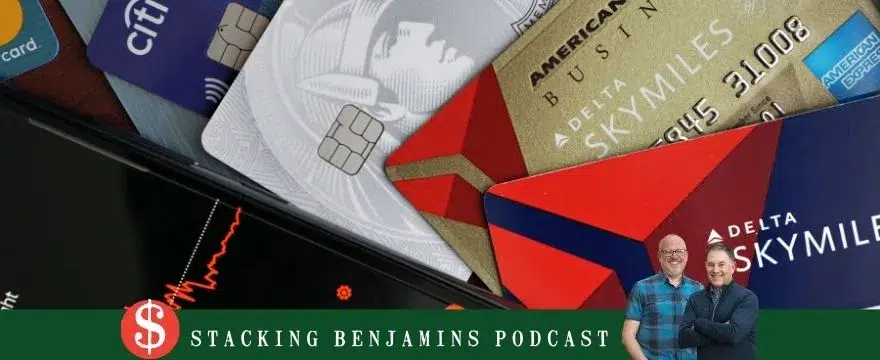
Credit card companies are getting smarter about one thing: making an $800 annual fee feel like a steal. Joe and OG open the vault on how the points-and-perks game actually works, why “free” subscriptions and dining credits aren’t really free, and the one simple piece of math that tells you whether a point is worth more than cash. Doug plays referee in a live round of Points, Cash, or Pass, and it turns out his instinct to keep one boring card in his wallet might be the smartest strategy in the room.
What You’ll Walk Away With:
- The 2% rule that tells you in five seconds whether a points redemption is actually a good deal or just a shiny number
- Why “almost premium” credit cards are the fastest-growing category in the industry, and who they’re really designed for
- The real reason card companies give you six months of free DoorDash or Apple TV, and why it costs you more than you think
- How to tell if you’re the kind of person who should play the points game at all, and why that’s not a bad thing to admit
- The one credit card rule that matters more than any rewards program: pay it off every month or none of this applies to you
- Why transferring points to an airline can either be a smart move or a trap, depending on one thing you do before you transfer
- The behavioral trick retailers use to get your card out of your wallet the second time, not the first
- What “stacking” points actually means, and why it’s the one place serious players find real value
Why This Matters Now:
Credit card rewards have quietly become their own side economy, with companies spending hundreds of millions of dollars to get you to sign up, swipe, and forget. That’s not inherently bad, but it works best when you’re the one steering it instead of the other way around. Whether you’re the type who wants a system for maximizing every point or the type who just wants one card and zero complexity, knowing the handful of rules that actually matter means you get the benefit without accidentally reshaping your spending to chase it.
From the Basement:
Doug gets put through a five-round gauntlet of Points, Cash, or Pass, and somehow nails every single one by refusing to play the game at all. There’s also a sticker system involved, a strong opinion about mauve wallets, and a trivia question about Breakfast at Tiffany’s that goes about as well as you’d expect.
Resources Mentioned:
The Points Guy — the go-to resource Joe and OG reference for maximizing point redemptions
Point.me — the tool Joe uses to compare redemption value across multiple loyalty programs
FieldKit — the budgeting app mentioned for tracking net worth, subscriptions, and credit
Monster: The Lizzie Borden Story — a mysterious bonus link that may or may not exist, and definitely isn’t some kind of secret extra segment. We’d never do that.
Deeper dives with curated links, topics, and discussions are in our newsletter, The 201, available at https://www.stackingbenjamins.com/201
Enjoy!



Our Headline
- The Rise of the Almost-Premium Credit Card (Wall Street Journal)
Doug’s Trivia
- What legendary actress played Holly Golightly in Breakfast at Tiffany’s?
Have a question for the show?
Want more than just the show notes? How about our newsletter with STACKS of related, deeper links?
- Check out The 201, our email that comes with every Monday and Wednesday episode, PLUS a list of more than 19 of the top money lessons Joe’s learned over his own life about money. From credit to cash reserves, and insurance to investing, we’ll tackle all of these. Head to StackingBenjamins.com/the201 to sign up (it’s free and we will never give away your email to others).
Other Mentions
Join Us Wednesday
Tune in on Wednesday when we head to Texas A&M to talk with Lauryn Williams, the only American woman to medal at both the Summer and Winter Olympics, about what it takes to win with money.
Written by: Kevin Bailey
Miss our last show? Listen here: Money Ideas That Sound Great Until You Read the Fine Print (SB1905) | Stacking Benjamins
Episode transcript
[00:00:00] opener: Hey, this is Joe’s sister Nikki. I think I might be the only girl in the world who has a brother who spends his entire day in the basement pretending he has an internet radio show
[00:00:19] Doug: Live from Joe’s mom’s basement, it’s The Stacking Benjamins Show
[00:00:33] Doug: I’m Joe’s mom’s neighbor, Doug, and remember those cartoons with a devil on one shoulder and an angel on the other? Today, we’re talking about the angel and devil of personal finance, Joe and O- I’m kidding. It’s credit cards. Of course, it’s credit cards. New data shows credit card companies are targeting you with hot new offers.
[00:00:54] Doug: So we’ll make sure you’re ready to go on offense with a great strategy. But that’s not all. Today, we answer a question from Nick, who’s wondering about insurances. Hey, Nick, we got you covered. And now, here come two guys who are your money friends every Monday, Wednesday, and Friday. It’s Joe and O. J- J- J- J- G.
[00:01:22] Joe: Happy Monday, Stackers. We’re super happy you’re here. I am Joe Saul-Sehy. I’m @AverageJoeMoney on X. It is credit card week on the show, and the guy who loves him a credit card sitting across from me. Mr. OG’s here. How are you, man?
[00:01:39] OG: I’m doing great, yep. Do love me some credit cards. We can play I’ll show you yours if you show me y- mine.
[00:01:44] OG: Or wait, I’ll show you mine if I show… Whatever, you get the idea.
[00:01:47] Joe: Y- yeah, I do get the i-
[00:01:48] OG: How many points do you
[00:01:49] Joe: have? I do get the idea.
[00:01:50] OG: Oh,
[00:01:50] Joe: God. Well, of course we have a game for Doug. We do have a game for Doug on today’s credit card show. It’s gonna be great. That’s the best part of the show. But actually, we are not a credit card show.
[00:02:01] Joe: We’re a financial planning podcast. But a basic piece of getting your financial plan in order is not to wreck it, and OG, you and I have seen plenty of people over the years that have wrecked their chance of financial security because, as Doug talked about earlier, the devil of the credit card gets in the way.
[00:02:18] Joe: We gotta make sure that doesn’t happen.
[00:02:20] OG: Why do I have a picture in my mind of, um, the lady from Waterboy saying, “
[00:02:25] Doug: Credit cards
[00:02:26] OG: are the devil”?
[00:02:27] Joe: Yeah. And they can be. As you know- Eh, but
[00:02:31] OG: they can also pay for some hella cool flights.
[00:02:34] Joe: They can. They can do some great, great, great stuff in your life. So we’re gonna do credit card 101.
[00:02:40] Joe: We’re gonna talk about the basics. And w- what also scares me is I spent some time this weekend on some of these credit card stacking and how to maximize your point sites, and I could see somebody, OG, going there first before we do this credit card 101 piece that we’re gonna do today. And again, you know, you get super excited about it, you wreck the whole ship before it even sets sail.
[00:03:05] Joe: So we don’t wanna do that. It’s credit cards on today’s show. Before we talk credit cards, we have a couple sponsors who help us keep on keeping on. We’re gonna hear from them, and then OG, Doug, and I, we are helping you keep your wallet straight and maybe help you put a few Benjamins in your pocket. Well, FieldKit is here.
[00:03:26] Joe: If you’ve missed my walkthroughs, man, you don’t realize what you missed. We built the equivalent of Superman for your money. It’s a budgeting app. It cancels subscriptions. It protects and helps you build credit, tracks your net worth, so much more. It’s the super app that keeps your money on track. You don’t wanna spend time managing your money, especially with us talking credit cards today.
[00:03:48] Joe: How important is you… How important i- is it for you to keep all that in line? Super important. StackyBenjamins.com/FieldKit to learn more.
[00:04:05] Joe: I was reading the Wall Street Journal, as I am prone to do, and, and I saw this piece that was written by Ben Glickman and Jazmín Lee, The Rise of the Almost-Premium Credit Card. This got me thinking about today’s topic. Ben writes, “It used to be that $500 would get you a premium credit card. Now it gets you something just below that.
[00:04:29] Joe: The popularity of ultra-luxe cards with ever-higher annual fees has led to a reshuffling in the market, with cards just below that tier now making up a new category for the not-quite-rich-enough.” Maybe my favorite phrase, not quite r- almost rich, not quite rich enough. “These near-premium cards are increasingly being aimed at younger Americans eager for travel, dining out, and the merry-go-round of other life experiences constantly on display on social media and in pop culture.”
[00:04:57] Joe: That, of course, OG, made me groan. It also made me think, you know what? It’s been a while since we’ve gotten into budgeting and just wallet management 101 and the credit card game. So Cards with $700, $800, almost $900 annual fees, OG, creating this new category underneath them. You still get the metal card, right?
[00:05:18] Joe: ‘Cause you want the metal. You still get travel rewards, you still get dining perks, but apparently now we have the credit card equivalent of premium economy. As we see the like the rise of premium economy on the plane, we’ve got premium economy in credit card land. What do you think about these? Trap, or maybe a way for people to bump up a level?
[00:05:40] OG: Well, I think the article, what it’s saying is, is a lot of the cases you can get what you’re looking for, for not having the $900 a year fee card, and sometimes actually the next tier down is a better value. Ultimately, when it comes to the points chasing type of scenario, you have to evaluate what you’re spending on, what you benefit from, or what you value in terms of, you know, the output that comes from your Amex card or your Visa or whatever you got.
[00:06:10] OG: But the biggest thing is you have to even see whether or not you’re responsible enough to have credit cards. And what I mean by that is if you’re one of the, I don’t know, what’s the number today? 60% of Americans that has a credit card balance month to month, it doesn’t matter what point program you have, you’re losing your you know what to interest, because there’s no points program that is better than paying off your credit card bill every month.
[00:06:33] OG: If you can’t pay your credit card bill off every month, I don’t know what you’re doing with credit cards to begin with. In, in which case you should just, uh, you, you don’t need any points programs.
[00:06:42] Joe: Yeah, the best point program is the one where you get points, you avoid interest rate points. You avoid
[00:06:48] OG: interest points.
[00:06:49] OG: Yeah. Yeah.
[00:06:50] Joe: But yet, OG, they get us with the cool textures. I mean, they get us with all the feels, the different colors of the card. Now, I gotta tell you, I’ve got the American Airlines card, and we’ll talk about why I have this particular card, but I’ve handed it to waiters before, and waiters just, they, they get the card and they go, “Ooh.”
[00:07:10] Joe: Like there’s this little, oh wow. Doug, how much would you pay annually for a credit card if it were sufficiently heavy and a pretty color?
[00:07:19] Doug: Well Joe, my wallet does need some interior decorating. I’m missing out on kind of a mauve in my wallet, so if I can get one of those cards I’d probably give it a good, I don’t know, 150 bucks a year, 200 bucks a year just to get the color scheme.
[00:07:33] Joe: Yeah, my friend Trevor does this thing called rucking. You guys familiar- Yeah … with rucking where you put weight on your back and you go hiking?
[00:07:39] OG: I did it for a job. It sucks. It’s, it’s amazing to me that people think that this is actually fun.
[00:07:46] Joe: You- “
[00:07:47] OG: I got an idea. Let’s go play soldier boy for a week.” Um, how about not?
[00:07:52] Joe: But if Doug gets a, gets a heavy enough credit card, Doug, you could consider it rucking. Just put that in your wallet and there you go. You got that. But I think there is this important thing, OG, which you referenced, which is does this thing actually make us money or are we trying to spend money justifying owning it?
[00:08:08] Joe: So before we talk points, who shouldn’t be playing this game? You mentioned people carrying a balance. Who else shouldn’t be playing the game, OG?
[00:08:20] OG: Um, you know, just straight up like the points game, is that what you’re talking about? Or the rewards game?
[00:08:27] Joe: Yeah, the rewards game.
[00:08:29] OG: I think that it’s a really slippery slope if you don’t have a bunch of time and energy to dedicate toward wasting time, and I don’t mean that in a bad sense.
[00:08:38] OG: I’m just saying, like, if you’re trying to optimize every dollar and take advantage of signups, bonuses, and all that sort of stuff, uh, probably the leader in this category is The Points Guy, and many people are familiar with Brian and his work and all the platforms that they do. But one of the things that he talks a lot about is if you’re gonna play this game, it’s…
[00:08:58] OG: This is your side project. You need to pay attention to all the rules and regulations around the value that you’re trying to get because a lot of times the value isn’t necessarily in the fact that you’re getting a point. It’s the benefit of getting 200,000 of these points because you just got the brand-new card.
[00:09:16] OG: But if you miss the signup or you miss the time or you miss the dollars, or worse yet, you manufacture the spend to get it, and then you end up with the interest payments, like we talked about before. “So I could get my signup bonus, I needed to charge this thing, and now I can’t pay it off.” And, you know, you’re just, you’re chasing the wrong thing at that point.
[00:09:36] Joe: Yeah, if you hate complexity, like if you’re somebody that just naturally- Yeah … does not like complexity, this is not for you at all ’cause-
[00:09:43] OG: Probably not
[00:09:43] Joe: a- … they make it complex on purpose.
[00:09:46] OG: Well, sure. Yeah, I mean, they’re not trying to give away money.
[00:09:49] Joe: I think also, you know, people carrying a balance, people hate complexity.
[00:09:53] Joe: I also think there’s this tendency when you’re chasing rewards to spend money that you don’t have, OG, or to just spend money in a way that you wouldn’t. Like, if you’re somebody that sees different rewards and you’re like, “Oh, well, I could upgrade this dinner that I really don’t care about and it’ll just give us more points.
[00:10:09] Joe: I can afford to pay for it, but why am I spending money on stuff I don’t value to chase points?” Doesn’t make any sense to me either.
[00:10:16] OG: The other thing that I’ve noticed recently in terms of the complexity and spending money you don’t need to spend type of merging of those things here is the advent of credit cards giving you something that costs money on a subscription basis for free for a short period of time- Oh.
[00:10:32] OG: because you have the card. Oh. So it’s like, you get six months of DoorDash Premium with this card It’s great. Six months for free, how awesome is that? Well, guess what happens, of course? DoorDash is willing to pay Chase $100 million to get, to get, you know, 7,000 or 70,000 or 700,000 people to sign up for this thing for- New signups,
[00:10:52] Joe: yeah
[00:10:52] OG: six months for free because the vast majority of them forget that it’s even there, and you know what? I mean, hey, it’s 10 bucks a month. Who gives a crap? It’s only 10 bucks. But you do that for that, and then you do it for Apple TV, and you do it for Disney, and you do it for, you know, Uber Eats, and you do it for all these other, Peloton, and every single solitary company that can get their fingers into a credit card rewards program and say, “Well, we’ll give this to you for free for six months.”
[00:11:17] OG: And now you’re spending thousands of dollars a year on subscription fees.
[00:11:23] Joe: Level number one is pay off the card in full. If you don’t, ignore the whole game. Number two would be what a good friend in the credit card industry told me, which was, “You know what? If you don’t wanna play any of this, if you don’t have time, you don’t like complexity, you pay them off every month, find a cash back reward card that gives you at least 2%.”
[00:11:45] Joe: If you get 2% cash back- Yeah … you don’t have to play any of this. You just get cash and it’s done. I think that… Isn’t that what you carry, Doug, is a cashback
[00:11:52] Doug: reward card? That’s the only game I play. I’ve- Yeah … I’ve been a big fan of it. Frankly, I don’t need to go to an ATM all year long. I go so infrequently that when I do go to an ATM, I get fraud alerts immediately from my bank.
[00:12:04] Joe: Is it really you?
[00:12:05] Doug: Yeah. Th- like I… At best, I get a thing on my phone right away that says, “Somebody’s trying to use your card.” Yeah, I know it’s me, but that… I’ve had several years in a row where I don’t go to the ATM because I get cash from Costco, ’cause I just… I pay it all off every month. I buy everything I possibly can at Costco, and, and all my utilities and everything else that’ll allow me to put it on the, on the card.
[00:12:27] Doug: And it’s, like I don’t… I’m not gonna mess with, oh, I’m gonna use this card ’cause it’s better for restaurants and this card’s better for, I don’t know, taxi rides or something. No. I’m just… it’s one card.
[00:12:38] Joe: Yeah.
[00:12:38] Doug: Cash back.
[00:12:39] Joe: My main card is the American Airlines card I was referencing earlier. Yeah. But that’s because I travel enough.
[00:12:46] Joe: The problem is, though, for me, is it does create a bunch of complexity. I’m not getting a card that is the top card, which is why I don’t spend a lot of time looking at the points guy. I’m solving specifically for American Airlines. Like specifically. Yeah. I, I… The cool thing about Texarkana, Doug, I don’t know if you know this, but you can travel any airline you want as long as it’s American.
[00:13:07] Joe: As long as it’s
[00:13:07] Doug: American, and you need to go
[00:13:08] Joe: where they go. You can go anywhere you want in the entire world, as long as it’s Dallas, and you can go any time you want, as long as it’s 6:00 AM or 2:00 PM. Like that is it is incredibly flexible. So if I’m solving for that, then I’m solving for how do I, how do I max out this, uh, American Airlines program?
[00:13:28] Joe: But I think this idea for rewards alter your spending behavior. If they change the way that you’re spending money, then it’s bad. Like with cashback, the cool thing is you’re not gonna go crazy on cashback going, “Oh, guess what? I’m getting, I’m getting two cents back-
[00:13:42] Doug: Right …
[00:13:43] Joe: for each, for each dollar it d- needs.”
[00:13:45] Joe: You’re not gonna play that game at all with a cashback card.
[00:13:47] Doug: Yeah, I don’t… I could, ’cause I, there, it’s tiered. A lot of the ones that are just cashback are tiered based on the kind of things you’re spending money on, gas versus- Yeah … travel versus restaurants. Sure. And I suppose, uh, it could, if I allowed it to, I could say, “Oh, I’m gonna go buy this.”
[00:14:03] Doug: But I just don’t, ’cause it’s just too much thinking, and I’m gonna buy what I wanna buy or need to buy anyways, and if it happens to be… ‘Cause it’s all going on one card. I have one credit card. So it’s all going there anyway, so I don’t really need to try to game it. I’m not gonna use one card for food because that one gives me more on food.
[00:14:20] Doug: It’s just whatever their plan offers is what I’m getting back
[00:14:25] Joe: I created a sticker system. I have three cards. I created a sticker system of green for gas, so I pull out the one that has a little green sticker on it, blue for restaurants, and then, uh- ‘Cause you’re
[00:14:36] Doug: always sad after you go to the bad restaurants, that’s why you chose blue?
[00:14:41] Joe: That’s right, ’cause
[00:14:41] Doug: it makes me blue. I… Too much. We’re talking about reward programs, and you also mentioned earlier, Joe, if these things are things that bring you joy and you need… The problem with credit cards is it allows us to circumvent that thought process of, “Is this something I need?” And you get to go buy it.
[00:15:02] Doug: It… There’s no pause involved to make you think, “Is this something I should be buying?” And that’s my issue with all of the cards and, and trying to play the game system, because you’ve replaced the real denominator of the equation of need with the game that the credit card companies want you to play with their rewards system.
[00:15:25] Doug: And that’s my apprehension with trying to get into multiple cards. Then I’m not thinking about the right thing anymore. The right motivator is not top of mind for me.
[00:15:36] Joe: Well, why don’t we go meta, Doug? You’re talking about the credit card game they want you to play. Let’s play a game about the credit card game.
[00:15:43] Joe: All right, Doug, here’s the game. I’m gonna give you a situation. You have three choices. OG’s gonna opine on your pick.
[00:15:51] Doug: I think we know what his opinion is going to be- … on every single one of my answers.
[00:15:58] Joe: We don’t gotta call him OG. We tell you to call him the opinator. Uh, you can go points, chase the reward opportunity. You can go cash, take the simple guaranteed value. Or you can pass because the deal’s trying to make us do something, Doug.
[00:16:12] Joe: Points, cash, or pass. You ready? Yeah. The welcome bonus. You are already gonna spend $4,000 in the next three months. There’s a card that offers you a huge welcome bonus if you spend the $4,000 in that period. Points, cash- Pass … or pass. Y- You pass on the reward bonus even if you were gonna get the 4,000 bucks.
[00:16:37] Doug: Yeah, because it means another card, and I don’t want… I want one card in my wallet, unless it’s a pretty color. That changes my answer, if it’s a pretty color or if it’s, like, you know, made out of plutonium or something. But otherwise, I’m passing, because I like to simplify my life. I want one card.
[00:16:54] Joe: OG, what are you doing in this case?
[00:16:56] OG: Well, I think for Doug’s sake, I would say, you know, it might make some sense to get a bonus point thing or something. I mean, you like to travel. You like to spend money on golf. So maybe you could get your next flight to the UK paid for or something like that.
[00:17:10] Joe: Yeah, I think this is passing up free money if you were gonna spend it already.
[00:17:15] OG: The thing that it requires is it requires a lot of planning in advance. Let’s say that you’re doing a, uh, backyard remodel project, and you said, “Hey, I’m, I’m, I’m putting in a new grill. I’m putting in a- an outdoor refrigerator. You know, I’m gonna buy some furniture for the patio, maybe a ceiling fan.” You knew that those expenses were coming, and they were budgeted, and then you also knew that there was a, a program that had a good sign-up.
[00:17:42] OG: I think you could do all that. I think what happens for most people is not that, is not that linear. I think most people go, “Oh, I read online that, uh, Chase has a 200,000-point sign-up. I should do that, ’cause who doesn’t want 200,000 points?” And, uh, “Oh, crap, I gotta spend 20,000 in the next six months? Okay.
[00:17:59] OG: I mean, I’ll figure something out.” You know, it’s that sort of reaction. I think that’s what Doug’s point is, is like- Yeah … A, I don’t wanna be trying to color-code my credit cards in my wallet to be like which shade of red is patio furniture. What kind of
[00:18:13] Doug: loser does that?
[00:18:14] OG: Yeah.
[00:18:15] Joe: Yeah. Who would do something like that?
[00:18:17] OG: What do you do when the colors fade? And you’re like, “Is this green or blue?”
[00:18:22] Joe: I think the problem is if the spending should earn the bonus, not the bonus create the spending, right? The credit card company- Yeah … wants you to go, “Four grand, put it on this card.” You’re like, “Oh, man, I’m not gonna spend four grand, but I can now, ’cause I’ll get a free welcome bonus.”
[00:18:37] Joe: Yeah. Well, you paid for it. All right, uh, question number two, Doug. Here we go You’re booking a hotel. The cash price is $400, but you have 20,000 points available, and it costs 20,000 points. Do you use the points? Do you pay the cash?
[00:18:57] Doug: Yeah, I gotta pause on answering that because I normally… I have a problem with points, and I have points at some hotels and points on some airlines, and I forget to use them all the time.
[00:19:10] Doug: I don’t dig into that aspect of it, and then they expire because I really hate that whole, the changing economy of points and how they can devalue them so fast. So I’m just so annoyed that I probably would end up just paying for it and not using the points because, not because I’ve made a conscious choice- You’re paying cash
[00:19:28] Doug: it’s not a strategy. It’s ’cause I’m an idiot, and I forget they’re there.
[00:19:32] Joe: It sounds like you’d use the points just to get rid of them. Just to
[00:19:35] Doug: get rid of them. Yes. Yes. That.
[00:19:36] Joe: I don’t care if it’s a good deal or bad, I’m gonna get rid of these points so I just don’t have any more.
[00:19:40] Doug: It’s clutter in my life. If I could remember that I had the points, I would use the points.
[00:19:45] Joe: There is a simple calculation to know if it’s a good deal or not, Doug, which is the 20,000 points, you drop the last two numbers. So in other words, the 20,000, drop two zeros, so now it’s 200, and then double it. B- which is basically find that 2%, right? Find 2%. It equals 400 bucks. So at this point- Whoa.
[00:20:08] Joe: Really? … 20,000, 20,000 points equals 400 bucks. I
[00:20:13] Doug: did not know that.
[00:20:13] Joe: Yeah. And then you know if it’s at least equal to the cash, if it’s a decent deal. If it’s less than that, which happens all the time, OG, I mean, credit card companies are gonna give you all these hotel deals that look splashy, but if it doesn’t have the 2% rule, you probably are doing better cash back.
[00:20:28] OG: I mean, if you have the opportunity to do cash back at 2% or points redemption at one and a half, you know, on, on paper the 2% cash is better. You have to have a 2% cash r- rewards card to do that. No credit card company is gonna allow you to reward the points at 2%. But I will put a little asterisk next to that and say the benefit of the points is, is it doesn’t affect your cashflow.
[00:20:51] OG: So if it is one of those scenarios where it’s like, “I didn’t plan on the trip up north because, you know, we have somebody sick in the hospital, and now I’m gonna be in the hotel for a couple nights, and I got…” You know, this is a great time to use those, even if the redemption dollars aren’t exactly perfect because you say, “I, I didn’t have in the budget $1,000 weekend hotel trip plus flight plus food and all that nonsense, but I do have enough Marriott points to pay for the hotel room,” or, “I’ve got enough Delta miles to, to do it.”
[00:21:20] OG: Even if the redemption sucks, it’s, at least it kind of doesn’t ruin your cashflow. Uh, Doug, what I will say to you about the point thing, I, I have, I have a similar… I have a lot of them, had a lot of them, and I would also forget to use them. Like, I’d be like, “Oh, I’m sure there’s a better redemption next time.
[00:21:35] OG: I’ll just wait.” And at the beginning of this year, I, I said, “I am not going to use any of my own money until I burn through all of my points.” I do not care because of the devaluation, because every year it’s like, well, that hotel room used to be 60,000, and now it’s 80,000. Because of that reason, holding onto them- Unless you have a specific purpose, you know, in two years from now we’re taking the family to- It’s a bad idea
[00:21:56] OG: you know, Europe and I’m gonna pay for the flights, just use them. And so I said this year I’m not paying for anything out of pocket until I burn all my points. And I’ve had some really crappy redemptions, but I’ve also saved a lot of cashflow by not writing checks for airline flights and- It’s Joe and Cheryl’s
[00:22:12] Doug: food in the freezer policy.
[00:22:14] OG: Yeah. Burn it. Just burn them up. See what happens.
[00:22:17] Joe: There have been several times when I’ve used them that I’ll get 2.5, 2.75%, sometimes 3%, which is pretty good on special deals. I like knowing though, Doug, that little calculation, but I’m also with OG. There’s been times when I’m like, “I just don’t wanna spend cash right now.
[00:22:33] Joe: I wanna cut the cashflow, so let’s do it.” And because I get some bonus points, because if you do play the game and you reach higher levels, like I’m in the Hyatt program, you get bonus points that you don’t pay for. So now you’re working with some of their money. Okay, number three. Doug, you’ve got 100,000 points.
[00:22:51] Joe: This is funny, this Doug, ’cause Doug hates points. But Doug, you’ve got 100,000 points and they’re transferable. An airline offers a 25% transfer bonus. That means your 100,000 is gonna become 125,000 if you take it from the credit card and move it over to the airline. Did this recently with a trip to Europe.
[00:23:14] Joe: Transfer the points, transfer the 100,000 to make it 125,000 in the airline, or leave, leave the points alone and don’t transfer?
[00:23:25] Doug: I, my inclination is to say I don’t feel like dealing with the math. I don’t enjoy math, so I don’t wanna do that.
[00:23:35] Joe: 20, 25% more.
[00:23:37] Doug: But then my next thought is, okay, but what does…
[00:23:43] Doug: 125,000 at the airline may be worth less to me, or less in their ecosystem, than the 100,000 where it’s currently sitting. So I’m gonna have to do that comparison before I just say, “Oh, 25% sounds good. I’ll take that.” Because if it costs me 400,000 to get a plane ticket, I’m no better off with 125 at the airline than I was with zero, ’cause I’m still not gonna be able to use it to get a ticket.
[00:24:12] Doug: So that, I’m sort of comparing the, the economies- Yeah … of those two worlds- Yeah … before I do anything. But more than likely, because that requires a lot of work, and I’d rather be golfing, uh, I will not do it.
[00:24:25] Joe: Yeah, and this is also a trap. It 100% is a trap, OG. Nice job, Doug, on that one. It’s a trap because unless I plan the trip already, if I’ve already planned the trip, I’ve looked at the number of points, and then I transfer and I get the 25%, which is what happened to me with British Airlines with that trip to Europe, then you’re not trapped to use British Air in the future.
[00:24:47] Joe: Because once I transfer it there, it’s stuck there. You know what I mean? If I take points that are usable in a lot of different places with my credit card, I move it to an airline, I don’t have to spend it on that airline, Doug. Exactly what you said. If I’ve got the trip planned, it’s a good idea. If I don’t have the trip planned, then I’m really trapping myself.
[00:25:05] Joe: Have you fallen for this one before, OG?
[00:25:07] OG: That’s a fun way to ask that question. Have you been an idiot like we think Doug would be?
[00:25:13] Joe: Well, my problem was, let me tell you what my problem was, ’cause I did get partially trapped. I did not do the point calculation ahead of time. So I transferred the points forgetting I was getting 25% more from British Air.
[00:25:25] Joe: So I get 25% more, but I transferred the exact number of points to get the redemption that I needed, and now I’ve got the tw- extra 25% sitting at British Airlines. So I partially messed this up.
[00:25:38] OG: Reminds me of this, uh, comedian where the guy said, “Who came up with the gift card? Let’s take money-” “… which is usable everywhere and turn it into money that’s only usable here.”
[00:25:53] OG: It’s like your credit card points. It’s like, “Let me take your credit card points which can be used anywhere and redeem for, against your statement balance, and let’s really focus ’em on one particular thing.” But yeah, you’ve gotta do the math on, on, like Doug said, to see if you’re gonna do it anyway, if this will make a problem go away.
[00:26:12] Joe: Yeah, only do the transfer if you’ve got it planned ahead of time. All right, we got some more scenarios for you, Doug. You’re not off the hot seat yet, but we’re actually going to turn away from the hot seat. Instead, shine the light on you ’cause you’ve got the Monday trivia question.
[00:26:27] Doug: Sure do, Joe. Hey there, Stackers.
[00:26:29] Doug: I’m Joe’s mom’s neighbor, Doug. You guys remember that song from the ’90s, uh, uh, Breakfast at Tiffany’s by Deep Blue something? You know, the, uh… It, it goes like, uh, “And I said, what about breakfast at Tiffany’s?” I’d sing more, but apparently, when you’re as good as I am, that’s how lawsuits happen. Anyway, for years I thought that song was about a guy trying to get back together with a woman named Tiffany, which I totally understood.
[00:26:53] Doug: I mean, I’ve had breakfast at Tiffany’s. Nice girl. Made a pretty decent Denver omelet. A little heavy on the peppers. Turns out, wrong Tiffany. The song was actually inspired by the classic 1961 movie, Breakfast at Tiffany’s, which premiered on this day 65 years ago. And the movie isn’t about breakfast or a woman named Tiffany.
[00:27:15] Doug: Tiffany’s is a damn jewelry store. Now, that’s just false advertising. That’s like making a movie called Lunch at Home Depot and then spending two hours watching a woman buy a belt sander. Anyway, Breakfast at Tiffany’s gave us one of the most i- Could be
[00:27:28] Joe: romantic for the right person. Could be very
[00:27:30] Doug: romantic Maybe.
[00:27:31] Doug: I mean, if you’re Ron Swanson, yeah. Anyway- … Breakfast at Tiffany’s gave us one of the most iconic characters in movie history, Holly Golightly. So today’s trivia question: what legendary actress played Holly Golightly in Breakfast at Tiffany’s? I’ll be back right after I give Tiffany a call. I never did return that Tupperware.
[00:28:02] Doug: stackers, I’m internationally renowned film critic and guy who gave The Godfather two stars ’cause there wasn’t enough parenting advice, Joe’s mom’s neighbor, Doug. Before the break, we were talking about Breakfast at Tiffany’s, the classic 1961 movie that apparently contains neither breakfast nor anyone named Tiffany.
[00:28:21] Doug: I still say that’s a problem. Fight Club, fighting. Hot Tub Time Machine, you got a hot tub, you got a time machine, boom. Those people understood how titles work. But Breakfast at Tiffany’s, no pancakes, no hash browns, not even one sad, soggy bowl of Raisin Bran. Instead, we get Holly Golightly, one of the most famous characters in movie history, wandering around New York looking glamorous and hanging around outside a jewelry store, which incidentally is exactly how Joe’s mom got banned from Kay Jewelers.
[00:28:49] Doug: So who played Holly Golightly? It was the legendary actress who won an Oscar for Roman Holiday, starred in My Fair Lady, and somehow managed to make eating a pastry on a New York sidewalk look classy. The answer is Audrey Hepburn. And Deep Blue Something, if you’re listening, I still think My Tiffany would’ve made a better movie.
[00:29:10] Doug: She had a Fiero and once got us kicked out of a Ponderosa. Fiero. Now there’s your movie.
[00:29:16] Joe: There’s some cultural references there. I gotta look up what a Fiero is and a Ponderosa. In the same trivia he gets a twofer.
[00:29:23] opener: Fieros were sweet.
[00:29:25] Joe: Audrey Hepburn, just what… Uh, if, if you’re… You know, my daughter right now is going through, with her fiance, they’re watching classic films.
[00:29:31] Joe: They just watched Casablanca this last weekend.
[00:29:33] Doug: Aw, how romantic.
[00:29:34] Joe: Breakfast at Tiffany’s is a nice one to watch. And Doug, you said you haven’t seen Breakfast at Tiffany’s?
[00:29:41] Doug: I have not.
[00:29:41] Joe: OG?
[00:29:42] Doug: There’s no way he’s watched this movie. How
[00:29:43] OG: many tanks or how many explosions are in it?
[00:29:46] Doug: I was gonna say nothing blows up in this movie.
[00:29:48] Joe: Well, then I’m wondering for some of those old movies, like some of the Westerns, like High Noon, did you see any of those? That would be an OG movie, an OG equivalent. No?
[00:29:56] Doug: Yeah. You’ve gotta watch some Westerns, don’t you?
[00:30:00] Joe: The silence says everything
[00:30:02] Doug: What about new ones like the 3:10 to Yuma? Oh. The new version of that, plenty of explosions and
[00:30:07] Joe: fighting.
[00:30:07] Joe: Doug, you showed me that one, remember?
[00:30:08] Doug: Ah, it’s a great
[00:30:09] Joe: movie. I came over to your house. You’re like, “We’re watching a movie tonight.” I’m like, “Okay.” And we watched
[00:30:14] Doug: 3:10 to Yuma. Super good.
[00:30:16] OG: Unforgiven. Oh. You’re calling Unforgiven a
[00:30:17] Doug: new movie? Lots of great fighting in that movie. No, we’re
[00:30:18] Joe: talking about classics.
[00:30:19] Doug: Well, it’s a new Western. It’s a modern Western. It’s, it’s a modern Western.
[00:30:23] OG: It’s not. It’s, like, almost 45 years old.
[00:30:25] Doug: Well, I mean, most people think of the Western genre as, like, the ’50s and the ’60s.
[00:30:29] OG: Yes, it’s not in black and white, basically. You’re right.
[00:30:32] Joe: Yeah.
[00:30:32] Doug: Yeah. Right.
[00:30:34] Joe: Treasures of the Sierra
[00:30:35] OG: Madre. It is in color, Doug, so I guess it does qualify as new-
[00:30:39] OG: relative to, relative to the times, to the times of your life .
[00:30:44] Joe: All right. Let’s get back to Doug’s credit card game ’cause I know he’s anxious to do another one.
[00:30:47] Doug: No, I’m trying to keep talking about movies to avoid- … the second half of this game. Let’s keep going.
[00:30:52] Joe: All right. We’ve gone through the transfer bonus, which is a trap.
[00:30:55] Joe: We’ve talked about hotels and how to do the 2% math, and we’ve talked about the welcome bonuses, right, that people get. Let’s go for this one, Doug. The card advertises a $200 dining credit. They’re gonna give you 200 bucks to go dine at a specific restaurant. Now, here’s the deal. You normally wouldn’t eat at this restaurant.
[00:31:18] Joe: But it’s 200 bucks. Would you not go to the restaurant? Would you take advantage of the free $200 because you had an annual fee, and it’s $200 toward the annual fee?
[00:31:30] Doug: No, ’cause, uh, I don’t go to restaurants anyways because when I get a steak, I want a giant, fat Costco steak that at a restaurant’s gonna cost 200 bucks for just the piece of meat.
[00:31:42] Doug: No, I’m eating at home because I can have two of ’em for less than what I would have paid at the restaurant, or I’m making myself eggs. I can make a dozen eggs. No one’s judging. They don’t do that at the restaurant for you, so screw that. I’m never using the $200 bonus at a restaurant.
[00:31:59] Joe: Well, here’s the thing, OG.
[00:32:01] Joe: I think, well, I, I don’t know if Doug got this one or not, but the
[00:32:04] Doug: It’s wrong …
[00:32:05] Joe: the $200 credit is really more about the evaluation period. A lot of people will justify the annual fee by looking at all the cool stuff, and you referenced this earlier with subscriptions that you might not need, that you end up on the hook for later.
[00:32:19] Joe: But also, OG, if these are things that you normally wouldn’t use, that you’re gonna start changing your habits just to justify the $800 fee on the credit card, you shouldn’t do it anyway. So if he wasn’t gonna go to that restaurant, don’t get me wrong, I think I would use it. I think I would use the $200 credit just to try out a new restaurant that time, but really when I’m evaluating the credit card, I’m like, “Does this make up for the fee or not?”
[00:32:41] OG: Well, and in more likely cases than not, the $200 credit is an annual credit given to you in quarterly installments, and therefore, it’s $50 a quarter. And to Doug’s point, that’s barely gonna cover a, uh, you know, a regular meal, let alone having a beer and a, the gratuity and all- Right … that sort of stuff on top of it.
[00:33:02] OG: So- Yeah … if you’re gonna do it anyway. The thing that I don’t like is the advent of the couponing on the credit cards, right? Where you gotta, like, go on the app and, like, select all the things that you might be spending money on in the next month and remember to do that. That’s super annoying. The annual credit thing, like this example, can be annoying if you’re gonna do it anyway.
[00:33:23] OG: It, you know, just basically knocks off 50 bucks off your meal. I know, like, American Express, for example, you can spend $75 a quarter at Lululemon, and they’ll, they’ll rebate you $75 a quarter, which in case you haven’t shopped there recently, is .9 pairs of shorts.
[00:33:39] Joe: Right.
[00:33:39] OG: So it’s so basically you’re getting a pair of Lulu shorts for the same price you could just go to Target and get a regular pair of shorts.
[00:33:47] Joe: I think they come up with that number on purpose. Like, seriously. The, so that you will have some money leave your wallet so you get the feeling of, “Oh, I bought stuff here before.” Like, you know, the whole game that retailers play.
[00:33:59] OG: Yeah.
[00:34:00] Joe: Behaviorally, if you’ve never shopped at a store, you have trouble reaching into your wallet.
[00:34:06] Joe: But once you’ve done it one time, all these behavioral studies show that once you’ve done it one time, then it, the, your card comes out of your wallet much easier. “Oh, it’s Home Depot, I always spend money here.” But if it’s the first time- What
[00:34:16] OG: percent of your spending, I’m kind of curious about this, because you’ve talked a bunch about the card, and the metal-ness, and you know, whatever, the, the, the panache factor.
[00:34:26] OG: What percent of your daily spending is tap-to-pay now versus getting the card out of your wallet, like that you use- Yeah … your phone with?
[00:34:34] Joe: No, that’s interesting. Cheryl uses tap-to-pay for everything, uses- Mm-hmm … tap-to-pay 100%, and is frustrated when a institution does not use tap-to-pay. I’ve never put it on my phone, because I know myself really well, and I need every little bit of friction I can get.
[00:34:50] Joe: So for me, I 100% always reach into my wallet and feel the credit card come out, hand it to the person.
[00:34:58] OG: Hmm.
[00:34:58] Joe: How about you? You tap to pay?
[00:35:00] OG: Yeah, I mean, it is predominantly that now. Yeah, uh, I mean, even restaurants now just have it. They have the little device and-
[00:35:09] Joe: Bing,
[00:35:09] OG: yeah … you know, they’ve tried to figure out how to handle the awkwardness of the gratuity, and I think the best way that I’ve found that some places do, is they, like, literally bring you the tap-to-pay thing, set it down and go, “And this is ready for you when you are.”
[00:35:22] OG: And they just walk away.
[00:35:23] Joe: And then the screen has it right there.
[00:35:25] OG: Yeah. Yeah, the old school, like, we’ll leave the receipt, and then you write the tip in, and then you close the padfolio thing, and you leave, and then they get to find out how much money they make. You know, it’s like this fun game. Because the hovering thing is kind of weird, right?
[00:35:38] OG: When they’re like, “Hey, it’s gonna ask you a question.” You know, they got their, their puppy dog with them, and the puppy dog’s looking all sad, like, “I wanna get a tip, right?” And you’re like, “Okay, fine, 20%,” but you really wanted to give them zero. ‘
[00:35:52] Joe: Cause, ’cause it was horrible service?
[00:35:54] OG: Yeah, I don’t even tip… I, I still tip people for horrible service.
[00:35:57] OG: That’s a whole different… We could, we could do a whole episode on tipping culture.
[00:36:00] Joe: I went through what was pretty much a buffet, serving myself.
[00:36:05] OG: Hmm. I would never tip for that.
[00:36:06] Joe: And it s- Zero dollars. At the end it says, “Tip” – Yeah … on the end of it. I’m like- Yeah … “Are you kidding me?” It was a make-your-own ice cream place.
[00:36:13] Joe: Like, you put- Hmm. Yeah, no … on these plastic gloves, and then you put your own ice cream in, and, uh- No … you know, the sprinkles on top and stuff. If
[00:36:19] Doug: I have to stand up or have any part to play in getting food to me, there’s zero tip.
[00:36:25] OG: Yeah, 100%.
[00:36:26] Joe: And who I feel bad for there is the employee of that restaurant.
[00:36:29] Joe: Because the owner, the owner has sold them on the fact that, “Hey, you know, you’re gonna get tipped, so I’m only gonna pay you dirt.” And then the employee gets taken advantage of, which frustrates all of me. Don’t get me wrong, not my problem, but still, incredibly frustrating.
[00:36:45] OG: Yeah. If you make my drink, I’ll give you a dollar.
[00:36:48] OG: If I gotta make my own drink… If it’s li- like, how about self-serve coffee where there’s, like, a little tip thing? Where they go, you go, “Hey, I’ll just take a black coffee.” And they go, “Oh, self-serve coffee’s right there. It’ll be, you know, $2.50.” And you’re like, ding. And then it goes, “Tip.” And you’re like, “No.”
[00:37:01] OG: What are you talking
[00:37:01] Joe: about?
[00:37:02] OG: Zero. Like, I’m doing it myself.
[00:37:04] Joe: Yeah.
[00:37:04] OG: You made it and said, “Hey, how many creams and sugars do you want in it? Okay, uh, here’s a buck.”
[00:37:08] Joe: But you know what? I’ve been behind people, and I can’t help but look. Oh, I know. And they hit tip. People
[00:37:12] OG: just don’t like the awkwardness of it.
[00:37:13] Joe: They still tip.
[00:37:14] OG: People don’t like the awkwardness
[00:37:14] Joe: of it. Yeah. It just, it sucks so bad. I’ve got an example of the discounts at a campfire a couple years ago. I’ve talked about this in a few places. They were comparing point programs for hotels, and Hyatt’s point program, far better than Marriott or Hilton’s, even though, and to our point earlier about degradation of points.
[00:37:34] Joe: So I g- I, I go in, I start accumulating Hyatt points. They devalue the program at the beginning of this year. Oh, gee. So to your point about don’t hang onto points, there’s one. Number two, though, was the Hyatt credit card. The Hyatt credit card comes with a few perks, but the big one is a free room a year.
[00:37:56] Joe: The annual fee for the Hyatt credit card is 95 bucks. If you’re gonna stay at a Hyatt anyway, why would I not carry this in my wallet and have the annual fee covered by a stay that I was going to make anyway? So in that case, I think we illustrate two things. Number one is that something I was gonna use already justifies the annual fee.
[00:38:19] Joe: Number two is don’t hoard points because they’re constantly devaluing them. All right, Doug, we got another one for you, ’cause I know you’re just chomping at the bit for another one of these. Round number five. Restaurant A, Doug, gives you 5X points if you eat there. Restaurant B gives you 2X points if you eat there.
[00:38:41] Joe: Of course you like restaurant B better. Where are we gonna eat?
[00:38:45] Doug: I’m gonna take a response from OG and say asked and answered. There’s no restaurant, as much as I like to eat, and it’s a considerable portion of what drives me, I, I will never choose a restaurant based on points Sorry, but points at a restaurant is just not gonna motivate me.
[00:39:04] Doug: It’s just not gonna, neither one of them- And it shouldn’t … is gonna get me to make a choice.
[00:39:08] OG: And I think the point is, is that it truly shouldn’t motivate you. What if they don’t judge you based on your 12 egg order?
[00:39:17] Doug: If, if I were worried about getting judged on that, I, I would’ve stopped a long time ago.
[00:39:22] Doug: No, I don’t. Yes. I could care less what that, that second glance when, uh, when I say, “I will have all of your eggs.”
[00:39:30] Joe: Let’s lean into this. Uh, and Doug, you’re off the hook now. Congratulations. Nice work on that.
[00:39:35] Doug: I got them all right, didn’t I?
[00:39:36] Joe: Yes, 1,000% right. Good work. Nice. There is a game, OG, for people that are going to play the points game, and this is why we leave Doug here, because Doug likes the simplicity.
[00:39:46] Joe: For people that don’t, I wanna spend a couple minutes on really where the opportunity is when you look at the points guy, and this is stacking points. If you can stack a point program on top of a point program, this is truly a place to win. So when you, when you do this, number one, which credit card gives you the better reward?
[00:40:06] Joe: I use a very simple sticker system so that I know which one’s going to do it. Number two is, also OG to your point, do you know enough about the perks of each card that they maybe give you a discount? I didn’t know. You told the, me this about our company card for Stacking Benjamins. You’re like, “We already get that.”
[00:40:24] Joe: I’m like, “We do?” You’re like, “Yeah, you need to look at the perks of having this particular credit card.” That was incredible. Know what perks you already have available. Number three, do any of the shopping or travel portals give you points on top of points? I saw a piece about Hyatt where if you book it through a specific portal, you’ll get points for the portal, and you’ll also get the Hyatt points, and it’s the same price as if I went directly through Hyatt.
[00:40:50] Joe: Like, if they’re marking up the price, well then maybe not, maybe not worth it.
[00:40:53] OG: Today’s episode brought to you by Hyatt. Joe really likes Hyatt.
[00:40:57] Joe: Check for the transfer bonuses. Are there transfer bonuses that are gonna happen? Are there transfer partners? And it seems like now, OG, with AI, it’s easier than ever to see if these points stack.
[00:41:08] OG: From a redemption standpoint, there’s a great place called points.me. That’s what I use. I know a lot of people use it also, um, where you basically can say, “Hey, here’s what I’m planning to do. Here’s all the, here’s all the stuff I got. I got Chase points, and Amex points, and Marriott points, and Hyatt points, and I got all the things.
[00:41:26] OG: What can we make happen to make this a, uh, you know, a great value?” And they can figure it out for you there.
[00:41:33] Doug: It seems to me that all of this discussion about should we get these cards and how do we use the cards that have the points- What they’re really trying to do, what these card companies are really trying to do is to get you to buy things you wouldn’t otherwise have bought, right?
[00:41:52] Doug: So this isn’t about what your goals are. This is about getting you to spend in excess of whatever your goals were gonna be. We can say, “Well, I was gonna travel to the UK anyways.” Maybe not. Maybe I wasn’t gonna go there, but because I get this card that gives me airline points, maybe I will go there now, and I don’t like how that erodes what my true core planning, financial planning and long-term financial independence planning is.
[00:42:20] Doug: So it’s, it’s one of the reasons why I, I know… I guess I know myself well enough to know I probably would start doing that if I had the food card or the, the traveling card, whatever That’s my concern with all of these things is that it’s just, it’s, it’s nefarious and sneaky
[00:42:38] Joe: Uh, it is nefarious and sneaky, but what’s interesting about it is if it’s something that you already like, I like going to a place that I didn’t know I was gonna go two weeks before.
[00:42:48] Joe: I had this trip that was canceled. A friend of mine got hurt. We were supposed to go to Santa Fe, New Mexico. All of a sudden I have, with American Airlines, I can go any place, assuming that the fee, th- you know, the airline fee’s gonna be equal to or less. So I already have paid for the flight. The hotel was canceled.
[00:43:05] Joe: I already have the time away. Now I can go any place. Well, I went to, went to Charleston, South Carolina. Two weeks before I had no idea where I was going. Spent a lovely week in Charleston. If you like playing that game ahead of time, then that’s great. If it’s gonna make you do things that you wouldn’t have done anyway…
[00:43:22] Joe: It was funny when we were even evaluating this, Doug, just looking at the fact that I could have gone to Hawaii, I could have gone to Paris. I would have had to pay a little bit more, right, for those places. But for me, that was, that was part of the game. So I think it starts with pay the statement in full.
[00:43:36] Joe: OG, you made that note right at the top. Never spend specifically, and this is, Doug, your rub, right? Don’t spend specifically to earn the reward. You’re afraid that you do that. Companies want you to do that, spend specifically to earn the reward. Know what your points are roughly before redeeming, and know how to do that 2% math, which is much easier than it sounds.
[00:43:59] Joe: Just get rid of the last two places on the points and double the number of points. There you go. There’s the cash equivalent. Never transfer points without a plan. Don’t just transfer points from one wide portal into a smaller one. I love the comedian reference. Don’t like gift cards. And then reevaluate every annual fee.
[00:44:18] Joe: Does that annual fee actually make sense, before you do it. That’s the 101 I feel like OG people don’t get before they go to some place like the points guy. They just jump into the points guy. Next thing you know, you’re knee-deep with five different credit cards that you’re really not sure why you have them, and you’re spending all this money on annual fees and having dinners at places where you wouldn’t eat and going on trips you wouldn’t-
[00:44:38] OG: Just giving shot after shot to OG all of a sudden.
[00:44:40] OG: I didn’t see why we had to do that- Is that you? … to finish this up, but okay.
[00:44:43] Joe: Did you do that?
[00:44:45] OG: What?
[00:44:45] Joe: Did you do
[00:44:46] OG: I don’t know. Like, you’re breaking up.
[00:44:51] Joe: I think the point here is we love points, we love perks, we love status, and we really love telling ourselves that an expensive thing is basically free because it went on our spreadsheet, right?
[00:45:02] Joe: Yeah. Cash might be the answer, points might be the answer, but you really begin with you. And I also like, OG, to really wrap this up, if you’re gonna do the points game, consider it your side hustle, ’cause it truly, if you’re gonna dive into it.
[00:45:16] OG: If you’re gonna do it, yep.
[00:45:17] Joe: Yeah. Your financial plan shouldn’t serve your points.
[00:45:20] Joe: Points should serve your financial plan. And remember, the big part of that side hustle is stacking points. Mm-hmm. ‘Cause when you can start stacking this welcome bonus on top of this portal bonus on top of this bonus on top of that bonus- Man, some people that I know go lots of places for free. Other people go lots of places, and they run up credit cards.
[00:45:42] Joe: It’s not a great idea. All right. Let’s mosey out on the back porch, Doug. We got a big Field Kit training tonight.
[00:45:48] Doug: Is this like when I was in Boy Scouts and they taught me how to pitch a tent?
[00:45:52] Joe: Kinda like that, but with your money. With your money. Can
[00:45:55] Doug: we light it on fire? Are we gonna, like, rub some nickels together and see if we can create a spark and light our money on fire for a camp?
[00:46:01] Joe: We’re gonna show you how to very simply track your budget, track your net worth, get your privacy back, all these people that are selling your data, track your credit, get rid of subscriptions. It’s all in one place. We’re doing that, Stackers, tonight on YouTube, 8:30 Eastern Time, 5:30 Pacific. Of course, that means 7:30 Central, 6:30 Mountain Time.
[00:46:26] Joe: You know how I know that, Doug? ‘Cause I know my time zones. That’s why.
[00:46:31] Doug: Congratulations.
[00:46:32] Joe: 8:30 Eastern Time, Stacking Benjamins YouTube page. Just go to YouTube, put in Stacking Benjamins, and you’ll see that we’re doing a Field Kit walkthrough. I love these because people ask so many good questions. We’ve done two of them so far, and it’s great to see two groups of people.
[00:46:50] Joe: Number one, users of Field Kit learning how to make even more happen with it, but then number two, love seeing people go, “You know, how come I don’t have Field Kit? This is the thing that I was looking for,” which is why we created it. It was actually the thing I was looking for. So gonna be great. All right.
[00:47:07] Joe: Big thanks to all of you for hanging out with us today. If you know somebody who’s contemplating the credit card points game, before you send them off to that points place, maybe direct them to this episode because I think you want the 101 of where to start before you get, uh, down and dirty. ‘Cause maybe Doug’s way of doing this, where you just go, “You know what?
[00:47:28] Joe: Cash back,” might just be a better way to handle the entire thing. Hope to see a bunch of you tonight on YouTube, but for right now, Doug, you’ve got it from here, man. What should we have learned on today’s show?
[00:47:39] Doug: Well, Joe, first, take some advice from you and OG. Credit card offers? Begin with your lifestyle and work backwards.
[00:47:47] Doug: Second, the best part of playing the credit card reward game is avoiding interest. That is the biggest reward any credit card can offer. After that, learn to stack your points just like you’re stacking benjamins. But the big lesson, don’t ask Joe’s mom if she’s gonna offer points for frequent garden weeding.
[00:48:06] Doug: She’ll just tell you she’s in development mode and send you outside to pull more weeds. This show is the property of SP Podcast, LLC, copyright 2026, and is created by Joe Saul-Sehy. You’ll find out about our awesome team at stackingbenjamins.com, along with the show notes and how you can find us on YouTube and all the usual social media spots.
[00:48:33] Doug: Come say hello. And oh yeah, before I go, not only should you not take advice from these nerds, don’t take advice from people you don’t know. This show is for entertainment purposes only. Before making any financial decisions, speak with a real financial advisor. I’m Joe’s mom’s neighbor, Doug, and we’ll see you next time back here at the Stacking Benjamins show
[00:49:47] Joe: Welcome to the after show. This is the part of the show that has nothing to do normally with money. It’s also the hidden part of the show. Doug, I saw a clip for a show. I had no idea what the show was until you just mentioned it. You saw a Netflix, a show about Lizzie Borden.
[00:50:07] Doug: Yeah, so Monster is, it’s a series I guess I’ll say.
[00:50:12] Doug: They only do like I’ll say one a year, and they focused on a, on a different murder or mass murder, not… whatnot, that’s not the right term, um, serial killer each time. They did the Menendez brothers, uh, as an example. Well, this installment is Lizzie Borden From Fall River, Massachusetts in 1892, I believe.
[00:50:42] Doug: You better buckle up watching this thing. It is intense. It is incredibly visual and graphic. When you think that this is based even a little bit on a true story, it sticks with you, man. Some of the imagery and some of the, the acting, especially the acting, this sticks with you. So there’s probably on- The
[00:51:04] Joe: beginning of this, even the little clip that I saw, which was largely about, I think it’s her mother, and what a- Yeah
[00:51:12] Joe: what a horrible person her mother is.
[00:51:14] Doug: Really a horrible person. Yeah. I mean, you, you get why Lizzie did what she did. Just snapped. It feels, like, justifiable on some- I
[00:51:23] Joe: might not have gone that far. I might not have gone that
[00:51:26] Doug: far, but Oh, okay. But, but, uh, I would say what really stood out to me in this, the, the general production quality feels like a super dark, macabre version of a Wes Anderson movie, and the acting is astounding.
[00:51:45] Doug: Even the one character that I’d say was not, or the one actor who was, was maybe not quite as good as, as the rest of the cast is still would be a standout performance in almost any other show or movie that you would watch. Just incredible performances. Not many people that you will, other than Charlie Hun- Is it Hunnam or Hunnam?
[00:52:08] Doug: Um, other than him, uh, and you, you… You know, people might recognize him. He’s the father. I don’t think there’s anybody here that, that I know is, like, a recognizable face, even though the mother that you talked about, she’s been in plenty of other stuff. I just didn’t recognize her.
[00:52:27] Joe: Yeah, I recognized her.
[00:52:28] Joe: Actually, I kept saying, “Is this her? Is this her?”
[00:52:30] Doug: Yeah.
[00:52:31] Joe: And, uh, turns out, yes, it
[00:52:33] Doug: was. And, and she was in… She’s been in a number of, of pretty, I’ll say, big, popular/big budget movies. I just didn’t spot her. But that doesn’t mean anything ’cause I don’t wa- watch a lot of those anyways. I would recommend this highly, but you’d better be prepared for, there’s a lot of graphic vi- I mean, look, I’m not telling any secrets.
[00:52:55] Doug: Everybody knows Lizzie Borden killed her parents with an ax, so, uh, it’s, it’s as graphic as you could imagine, but-
[00:53:02] Joe: So s- but spoiler.
[00:53:04] Doug: Yeah You should’ve
[00:53:04] Joe: said
[00:53:04] Doug: spoiler alert. Spoiler, from 1892.
[00:53:08] Joe: I can’t believe you spoiled the whole… Why would we watch it now?
[00:53:13] Doug: But, but yeah, the, the… And then it goes backwards in time to some of the, the things that sort of motivated Lizzie, and I mean back in time, I mean, like, couple hundred years.
[00:53:23] Doug: It goes forward in time at one point, and, uh, Sarah Paulson makes a, uh, makes an appearance. I wouldn’t even say cameo because it’s more than that. But she’s amazing. She’s, she’s a amazing actor. Um, so yeah, would, would recommend this, but the, the asterisk just has to be you better have the stomach for it just because of how much evilness there is, and not even just the act of the killing, but all of the stuff that motivates her to do the killing.
[00:53:54] Joe: Sounds like this is up OG’s, uh, alley.
[00:53:57] Doug: I think it’s- Perfect … I think it’s too arty for him, honestly. It’s a pretty-
[00:54:01] Joe: Yeah …
[00:54:02] Doug: a pretty arty, artistic presentation of all of this, so I don’t know that that fits with him. But the violence part- He doesn’t want
[00:54:08] Joe: artistic bloodshed. He just wants Mom to blow up.
[00:54:11] Doug: Yeah.
[00:54:12] Joe: If Lizzie Borden would’ve taken a hand grenade and blown up Mom- … he’d be like, “All right.”
[00:54:17] Doug: In slow-mo.
[00:54:18] OG: Yeah, not my jam.
[00:54:19] Doug: It’s definitely not your jam.

Leave a Reply